The public shotgun trial held in London in 1858 marked an important milestone in the development of the breech-loading game gun. It was prompted by months of claims and counterclaims about the superiority of muzzle-loaders versus breech-loaders in the letter pages of the weekly sporting newspaper The Field.
The trial was arranged and hosted by the newspaper, and was the result of much preparation. On the day, the muzzle-loader was judged victorious, and to its proponents, the matter was closed to further argument.
It wasn’t, leading The Field to hold additional public trials in 1859 and 1866, in search of a result acceptable to all. Because the 1858 trial was the first of its kind, it is worthwhile to consider the event and its results in greater detail, to better reflect on whether the accepted verdict on the superior performance of the muzzle-loader was truly merited.
The trial was held on April 9 and 10, 1858, at Ashburnham Park in London, after the intention of having a public trial was first announced by John Henry Walsh, editor of The Field, in the 2 January issue of that year: “One of the most interesting of the many discussions on sporting subjects which have lately occupied our columns is that which relates to the advantages and disadvantages of the breech-loader.
The subject, however, is now worn threadbare as far as argument is concerned; and nothing but a fair experimental trial, before an impartial judge, is likely to satisfy our readers. … On the points of safety and wear-and-tear it is impossible to come to any conclusion by any single trial; but quickness of loading and firing, good shooting, freedom from recoil, fouling, and some other qualities, may fairly be investigated and settled, if the experiments are carefully and impartially conducted. We therefore invite all those interested in the question to a trial of their several guns in some shooting-ground near London.”
Following the announcement, Walsh was beset by pleas from gunmakers needing more time to build the guns to be used in the trial, and from London gunmakers in particular, fearing having to compete with provincial gunmakers, whose successes could imperil their higher prices: We have received several communications from gunmakers – the writers requesting us to postpone the time fixed for the trial of the various shot-guns and rifles, in order to allow of their completing an article fit for competition.
We also hear that one or two London gunmakers object to the admission of any gun but those made by the London trade, because they say they may be beaten by one which is not safe. This is quite true; but they ought to be able to compete with the whole world, independently of the superior safety of the articles sold by them; and unless they can do so, they can only lay claim to the single quality of superior safety as a set-off to inferior shooting. …
"As the shooting season is now nearly at an end, and as for the present new guns will not be wanted, it will perhaps be as well to delay the time of the trial for a few months; but in this matter we should desire to be guided by the wishes of the trade.”
In the 23 January issue, Walsh continued on the subject of the public trial, and commented on the debate in general, bemoaning that instead of welcoming the upcoming trial, ardent proponents of both sides have become hesitant out of fear of the outcome, writing: “Both parties to the controversy seem content to write for ever, and arguments are plentiful enough; but when a trial is offered, with some exceptions there is a hanging back of those who were previously the most prominent as if from a fear of an unfavourable result.”
The Field received numerous suggestions regarding the proposed trial. Much of the debate focused on the classification of guns by bore and weight, and the allowance of an extra drachm of powder in breech-loaders, which was believed necessary to obtain comparable results due to gas escape, ‘windage,’ and ‘friction,’ all of which were sincerely held truths without evidence.
Several prominent gunmakers entered the discussion. Some, like William Greener, a strong advocate of the muzzle-loader, remained steadfast, but was also prophetic, writing in the 6 February issue: “There can be little doubt, in my opinion, as to the muzzle-loaders winning the day this trial; but, if another trial was to take place twenty years hence, the results might be different, as the breech-loaders will no doubt, in time, meet with the improvements requisite to enable them to compete with the old-fashioned gun.”
In the 20 March issue, readers of The Field were notified of the programme and rules of the trial at Ashburnham Park. The three tests of the trial concerned driving power, as measured by the number of sheets of brown paper pierced at 40, 50, and 60 yards, the regularity of delivery of the shot at each of these distances within a 30-inch square, and the amount of recoil, both when clean and after thirty discharges, as measured by a spring device created for the purpose and attached to a fixed rest from which all shots were to be fired.
The 17 April issue provided a full account of the 1858 public gun trial, and not everything went to plan. April 9 was ‘bitterly cold and wet,’ hardly the best conditions for the event. The recoil-testing scale failed, and efforts to measure recoil were abandoned. Setting up the guns to shoot from a rest proved so time-consuming that in the end, all shots were fired from the shoulder. Instead of a 30-by-30-inch square target, an oblong shape, 28 inches by 11 inches, was used to save on the cost of paper.
The targets were of stout brown paper folded forty times for the 40-yard distance, thirty for the 50-yard distance, and twenty times for the 60-yard distance. The powder used was Lawrence’s No. 2, and the shot size No. 5, which was selected to ease the task of counting.
Guns were grouped into classes by bore, weight, and barrel length. All guns were double-barrelled. Class I was for the 12-bore, with weight not exceeding 7 ½ lb and barrels not more than 32 inches in length; this pitted five breech-loaders against six muzzle-loaders. Class II was for the 13 bore, weight not exceeding 7 ¼ lb, and barrels not more than 32 inches; one breech-loader competed against one muzzle-loader.
Class III was for the 14-bore, weight not exceeding 7 lb, barrels not more than 32 inches; two breech-loaders competed against six muzzle-loaders. Class IV was for the 15 bore, weight not exceeding 6 ¾ lb, barrels not more than 30 inches; two muzzle-loaders were shot without a competitor. Class V was for the 16-bore, weight not exceeding 6 ½ lb, barrels not more than 30 inches; however, on the day, none competed, and additionally, one overweight 12-bore breech-loader was tested. The guns of Classes I and II were tested on the first day, and the remaining classes were shot on the second day.
the report's attention was given to the results for the 12-bore guns
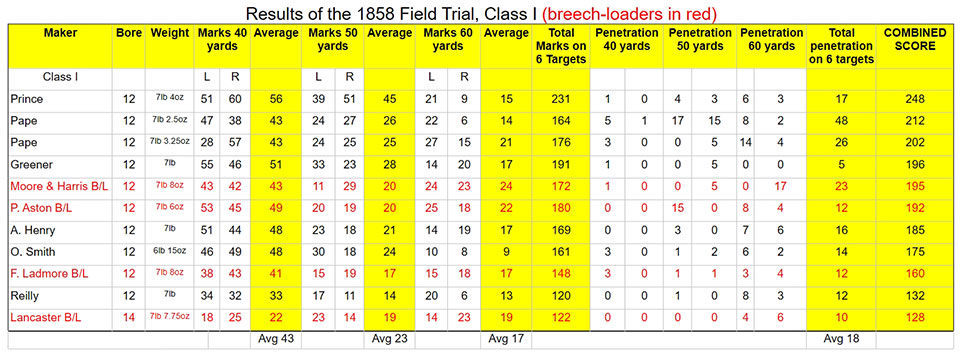
All of the results were published in a detailed table, outlining the owner of the gun, the maker, a description of the type, the bore, length of barrel, weight of the gun, powder charge, shot charge, number of marks on the targets at 40, 50, and 60 yards (for each barrel), and the number of shots successfully piercing the folded-paper targets (for each barrel). Cumulative scores for total hits and total through-shots on six targets for each gun were also provided; the sum of these two totals was used to determine the final ranking of the guns.
Most of the report's attention was given to the results for the 12-bore guns (Class I). The muzzle-loaders competing were: one by Frederick W. Prince of London; two by William Rochester Pape of Newcastle-on-Tyne; one by William Greener of Birmingham; one by Alexander Henry of Edinburgh; one by Orlando Smith of Derby; and one by Edward Michael Reilly of London.
The breech-loaders included a Charles Lancaster base-fire, and the rest were pin-fires with the forward-underlever configuration (described as ‘ordinary French breech-loaders’), with one by William Moore and William Harris of London, one by Christopher Penrhyn Aston of Birmingham, and one by Edwin Ladmore of Hereford.
The Editor of The Field, John Henry Walsh, reported the winning order: “It will appear that in the first class the 1st, 2nd, 3rd, and 4th guns were muzzle-loaders; while the 5th and 6th were breech-loaders, the 7th a muzzle-loader, and the last two both breech-loaders, one being the make of Mr Lancaster and used with cartridges filled by himself.
The conditions were that all the guns, as well as the cartridges, should be loaded in the presence of all; and this gun was tried with cartridges made by Mr Lancaster, but filled on the ground. The result, however, was so bad we decided, with the consent of all present, to use Mr Lancaster’s own, filled and sold at his establishment; but even then the shooting was as above described.”
In Class II, there were muzzle-loaders by Pape, Henry, and Reilly, and a breech-loader by Adolphe Jansen of Brussels, Belgium. Class III included muzzle-loaders by Pape, Greener and Reilly, by H. Fear [a maker I’ve been unable to trace], by Charles Culling of Wisbech, and two breech-loaders by Reilly. Class IV included only two muzzle-loaders, one by Greener and one by William Horton of Birmingham. One gun by Thomas Fletcher of Gloucester was unclassed for exceeding the weight limit set by The Field (at seven pounds and 12 ounces), but it was still fired and included in the results.
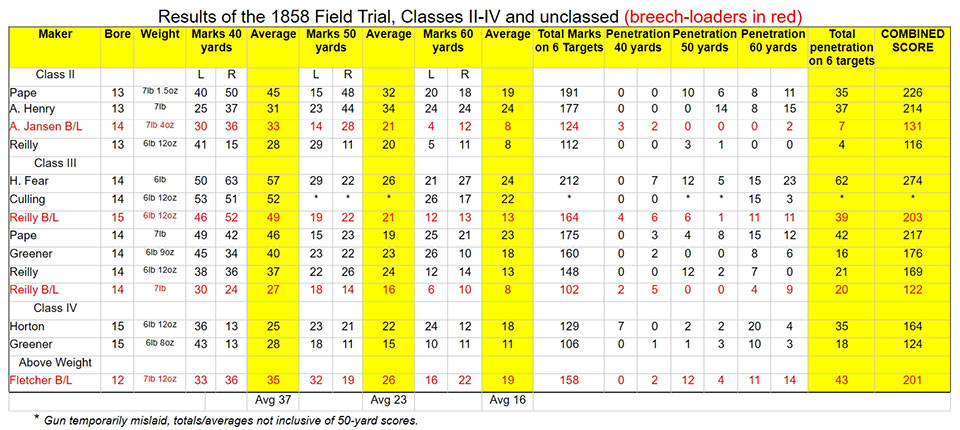
Walsh continued: “In the second and third classes it will be seen that the breech-loaders were again beaten, so that we were quite right in admitting of the handicap in their favour [allowing an extra half-drachm of powder], and after all find that the allowance made was not sufficient.” The results of the fourth class were included in the table but not discussed, as no matching breech-loader could be obtained, and the fifth class was empty.
As a summary on the breech-loader, Walsh concluded: “Whether their superiority in other points may be considered an equivalent, we offer no opinion, or they may yet become more regular and penetrating in their delivery; but at present we are satisfied that they are beaten by the muzzle-loader in the points upon which they were here tried, as will be apparent to anyone who examines the annexed table.”
I decided to take up the Editor’s challenge, and examined the Class I patterning results in detail. On 40-yard targets, two breech-loaders equalled or surpassed the second-place muzzle-loader; on 50-yard targets, the muzzle-loaders were superior, but on 60-yard targets, the Moore & Harris and Aston breech-loaders surpassed all the muzzle-loaders.
Overall, on patterns alone, breech-loaders were a close second place. On the penetration results (40 sheets thick at 40 yards, 30 sheets at 50 yards, and 20 sheets at 60 yards), the tallies varied greatly and lacked consistency, and at 60 yards, the Moore & Harris breech-loader handily beat the day’s ‘winning’ gun from Frederick Prince.
In Class II, the Jansen breech-loader patterned equally well at 40 yards, but poorly after that. The Belgian gun managed to pierce the 40 thicknesses at 40 yards while the muzzle-loaders couldn’t pierce any, though it fared less well at the longer distances. One of the two Reilly breech-loaders patterned equally well at 40 and 50 yards, and did very well on the penetration test. The slightly overweight Thomas Fletcher breech-loader performed well against all classes and was ignored in the report.
The laws of physics apply to all guns regardless of their type...
The laws of physics apply to all guns regardless of their type, so it is hard to assign variation in penetration to anything other than normal variation in tamping powder, pellet deformation, tightness of the paper folds, and so on, so I’m not convinced much can be determined from the results.
The patterning scores perhaps provide a better measure for comparison, and I opted to conduct a two-sample independent t-test (Student’s t-test) statistical analysis of the data, choosing this method to determine whether the observed differences represented a statistically significant effect. I did this for the 40-, 50- and 60-yard patterning results, at both 5% and 1% significance levels. For all distances, the differences between the two types were not statistically significant.
Is this really a surprise? Well-made and tested shotgun barrels should produce adequate patterns (understanding that all barrels in the trial were cylinder bored, made prior to choke-boring), and similar powder and shot charges would have had similar flight characteristics. The trial was intended to address the fantastical claims about patterns, strength (especially at long ranges), and recoil.
While recoil could not be adequately measured in the trial, Walsh commented that: “on the average the breech-loaders exhibited recoiled quite as much as the muzzle-loaders.” Using the simplest method of totalling the hits on target and the number of pellets piercing the totality of folded layers, the muzzle-loaders did ‘win,’ just. But a more objective look at the data suggests that neither system outperformed the other, and some guns happened to perform better numerically on the day.
Some readers crowed over the results. Correspondent “CFW” wrote: “I do not think we shall hear any more of the superiority of the breech-loader’s ‘close and strong’ shooting qualities, whatever other advantages it may possess, it being in the late trial, to use a sporting phrase, ‘nowhere’…” Others recognized that breech-loaders were equal to, or at least adequate for, the task they were designed for, and the great practical advantages of loading, cleaning, speed of use, and safety outweighed any differences literally made on paper.
breech-loaders were equal to, or at least adequate for, the task they were designed for
Major-General Thomas Charritie wrote: “My opinion regarding the breech-loading system remains unchanged; for in the late trial, as published in The Field, there were double the number of muzzle-loaders to breech-loaders; and, even then, a breech-loader made by a country maker (his first attempt) was third – a good third, being only three pellets behind No. 2 in strength, beating fifteen out of seventeen guns on the ordinary percussion-cap principle.”
Walsh must have appreciated the debate was not quite over, writing as a final conclusion of the trial, “if we have not been able to effect all that we desired, we have at least laid the foundation for another and more satisfactory series of experiments,” thereby laying the groundwork for future tests.
Noted at the event were the London gunmakers Robert Adams, Henry Needham, James Lang, John Blanch, and the competitor Frederick W Prince. The absence of many top names in the competition, such as Joseph Lang, who introduced the breech-loader to the British market, did not go unnoticed. Walsh commented: “the great guns stood aloof, having everything to lose and nothing to gain by a competition with their provincial brethren; but perhaps next time they may see that they suffer more in reputation by their absence than they could possibly by being present.” That must have stung.
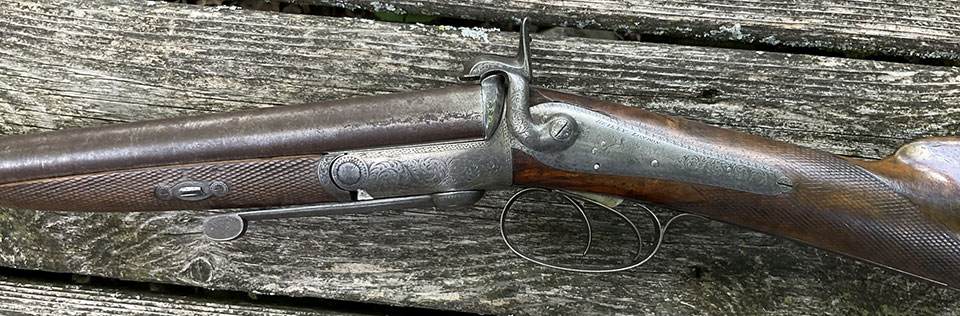
Despite the perceived loss at the trial, positive user reviews of breech-loaders continued to appear in The Field’s letter columns. A recurring theme developed in the comments was the concession that the muzzle-loader might shoot ‘stronger,’ but the breech-loader shot ‘strong enough,’ and its other advantages had to be considered in its favour.
I am convinced the results of the 1858 trial were inconclusive as to the battle of the systems, and not as definitive as The Field maintained. In any case, the newspaper felt the need to hold further trials in 1959 and 1866, as the breech-loader improved and its popularity amongst sportsmen peaked.
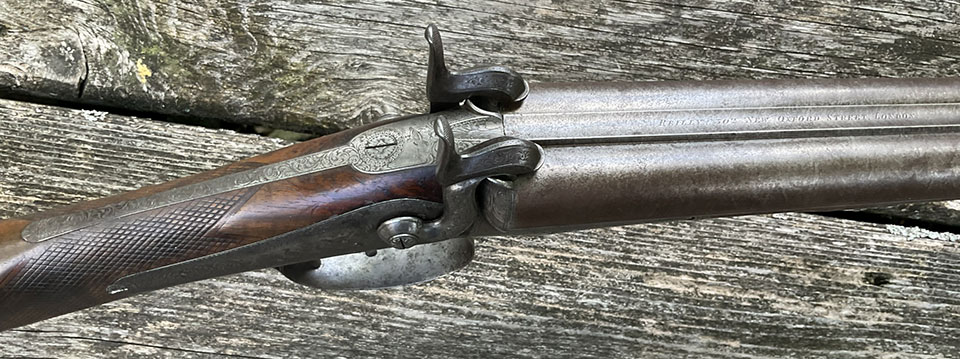
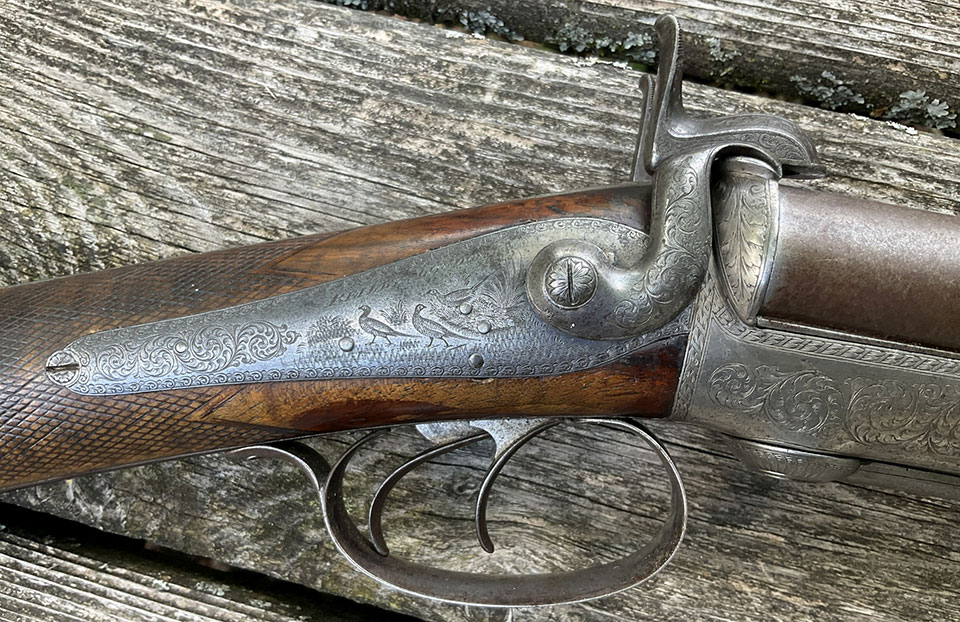
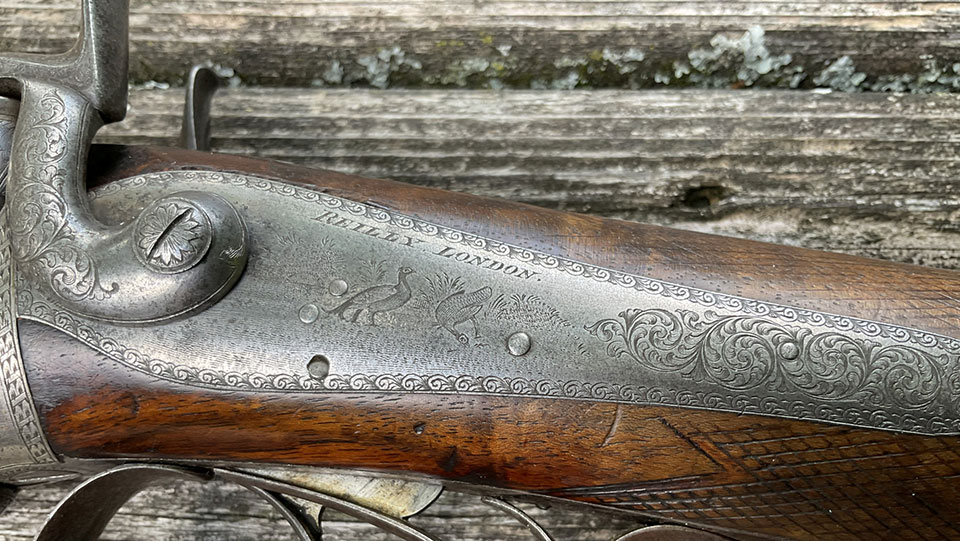
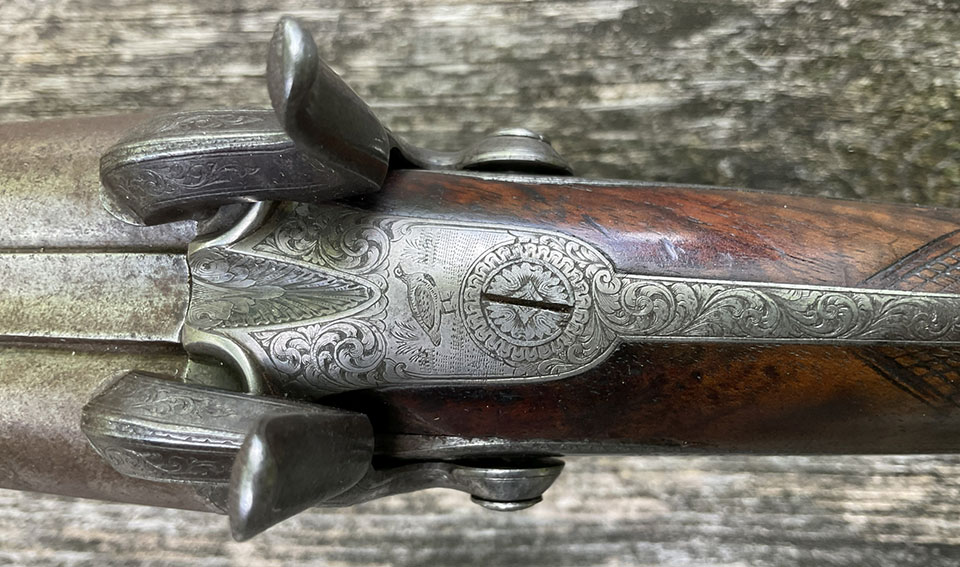
NOTE. Special thanks go to the E. M. Reilly expert, Mr. Gene Williams, who graciously provided the 1857-dated Reilly gun illustrating this article.
Stephen Nash
5 July 2026
Published by Vintage Guns Ltd on