J&W Tolley’s Loss Leader by Stephen Nash.
The Tolley name is forever associated with big-bore waterfowling guns and rifles, part of a range of products the firm produced, many aimed at Britons heading to distant lands and tropical climes. James William Tolley and his younger brother William Tolley founded their company, J&W Tolley, in 1858.
By the early 1860s, the firm was fulfilling military contracts, supplying cheap arms for the Africa trade, and building breech-loading guns. This latter endeavour was highly competitive, and a small and relatively new firm would have found it difficult to win a share of the limited market.
The Tolleys’ approach was to undercut their rivals with a breech-loader substantially cheaper than other gunmakers’ and to use The Field newspaper’s third public trial of 1866 to publicise it. It would be some 15 years before the firm would gain its reputation in building the big-bore guns and large-game rifles the firm would be synonymous with, and when James’s son, Henry, would patent his ‘Giant Grip’ action.
Building a reputation on quality alone takes time, and even the best-known names could only sell small numbers of breech-loaders in the first half of the 1860s. The newspaper had already held two public trials, in 1858 and 1859, in which the new breech-loading systems were pitted against the established muzzle-loader. The popular understanding was that muzzle-loaders won both trials, though in reality the results were very close.
A third trial was the perfect vehicle for showcasing significant advances in breech-loader designs and manufacture, and the Tolley brothers aimed to stand out by way of price. To anyone looking at the discussions in The Field up to this point, the cost of guns and shooting them was a significant concern.
the cost of guns and shooting them was a significant concern.
In October 1858, reader W. A. Adams countered William Greener’s assertion that a ‘perfect double gun’ cost £35 ‘and no less,’ with the claim that a ‘plain, durable gun, of the best material in barrels, and fine in workmanship,’ wholesaled in Birmingham at no more than £6 or £7, or £8 with engraving and a figured stock.
This provoked a series of respondents, several of whom itemised the cost of materials and services. Correspondent ‘E. P.’ sided with Greener, noting a pair of best barrels filed in Birmingham cost a gunmaker £4. 10s, a pair of the best locks at 3£, a stock at £1. 10s., and the furniture at additional cost.
All of these had to be paid for in advance before the gun could be built, and before passing through the hands of the craftsmen involved in building, regulating, and finishing, each of whom, as outworkers, would be paid for their work. A second- or third-quality gun could be had for a lower cost, but there was still a lower limit for producing a safe and reliable gun.
The debate continued in The Field’s columns, where subsequent correspondents argued that a first-rate gun should be had in Birmingham for no more than £25, while still allowing for a fair profit.
Reader ‘Truth’ decried: “I have seen gentlemen throwing away their money like water, and giving £30 and £35 for guns which I know for a certainty have been bought, finished, for £16 and less, at the manufacturer’s. I could name one of the first makers in England, who only charges £16 for what he calls a “keeper’s gun,” which is no respect inferior, except in engraving and finish, to a gun that his master will choose, for the say-so of the thing, to give £35 and more for. Any man who gives more than £18 to £25 for a first-rate double gun must have more money than wit; and £16 to £18 is amply enough.”
In 1862, the Birmingham gunmaker Charles Osborne advertised breech-loaders at £14. 14s. uncased, and in 1863, William Needham was offering a pin-fire breech-loader for £16. By 1864, the same question still shaped the discussion. In his weekly magazine All The Year Round, Volume XI, Charles Dickens wrote that: “A muzzle-loading double gun by a first-class London maker costs forty guineas; or, with its cases and all its fittings, fifty guineas.The leading provincial makers, and those of Scotland and Ireland, charge from thirty to forty pounds complete; most of their guns are, however, in reality manufactured in Birmingham, where the price of a double gun varies from twenty pounds to two pounds five shillings, or even less, according to quality.”
Dickens argued that London work was the best and worth the extra cost because of the quality of the workmanship, if, in fact, it was performed in London. His descriptions applied to muzzle-loaders, adding: “The price of breech-loading guns of best quality is five guineas more than muzzle-loaders; they are sold in Birmingham at from eight pounds to thirty pounds.”
Frequent Field correspondent and muzzle-loader enthusiast ‘Copper Cap’ claimed: “A good serviceable breech-loader, without case and all sorts of rubbish and flummery, ought to be able to be bought at from £15 to £20… I have no doubt that any gunmaker who would sell a really good, strong, well-got-up breech-loader at about £15 to £20 would have a very large demand for them.”
London work was the best and worth the extra cost because of the quality
John Henry Walsh, The Field’s Editor, usefully added: “The net cost of a London-made breech-loader of best quality varies from £23 to £27,” and “Birmingham-made breech-loaders are sold in London by many respectable tradesmen for £25, and in one instance they may be obtained for half that price.” A flurry of responses followed, naming London makers offering well-made breech-loaders for £15, £20, and upwards, including William Green of New Bond Street, Gustave Masu of Wigmore Street, William Watson of High Holborn Street, and the provincial makers Thomas Turner of Reading and Robert Stanton of Oswestry.
William Rochester Pape of Newcastle-on-Tyne advertised ‘a sound, plain, serviceable gun’ starting at £14. Nevertheless, the consensus of Field correspondents appeared to be that a reliable breech-loader would require a minimum £20 investment.
In the 27 January 1866 issue, Walsh wrote: “Since our last ‘Field’ trial of shot-guns, though the breech-loader has almost entirely superseded the muzzle-loader, yet the varieties of the former are so numerous that the intending purchaser of a gun is lost in attempting to investigate their relative merits. ‘Single and ‘double grips,’ ‘snap actions,’ ‘lockfasts,’ and ‘wedge-bolts,’ ‘central-fires’ and ‘pin cartridges,’ are only leading divisions, or captains of companies, each numbering many privates in its ranks. Week after week we are asked by our correspondents for guidance...”
At this time, the cost of a new breech-loader typically ranged between £20 and £40, uncased, with the higher prices sought for proprietary patents and best-quality construction. The Field proposed a public trial to test the new mechanisms, materials, and systems, and to help prospective buyers make informed decisions. The rules were simplified over previous trials.
For guns in the 12-bore class, the powder charge was 3 to 3 ¼ drachms of Curtis & Harvey’s no. 3, 5 or 6 black powder, and all guns shot 1 ¼ oz of no. 6 shot. The folded paper targets placed within the 30-inch circle were approximately 10 inches square, with penetration determined by the number of pierced sheets. Each barrel was shot six times, and the scores averaged and totalled.
The trial was held at the Lillie Arms, Old Brompton, London, on 22-23 May 1866. In the 12-bore class were thirty guns shot as thirty-two separate entries (two dual-fire guns were shot with both pin- and central-fire cartridges). Competing were sixteen pin-fires (with ten described as ‘Lefaucheux Breechloaders,’ a catch-all term for breech-loaders with forward- or rearward-facing underlever actions), eleven central-fire guns (of which eight were based on Charles Lancaster’s slide-and-drop design), one muzzle-loader, and the two dual-fire guns. All guns fell within the £20-£40 range, with one notable exception: James and William Tolley entered their 12-bore pin-fire game gun at a declared price of £8. 8s. This was less than half the cost of any of the other competing guns, and far below the top range of London offerings. It was smart to focus on price, considering how persistent the discussions were on the subject in The Field’s pages.
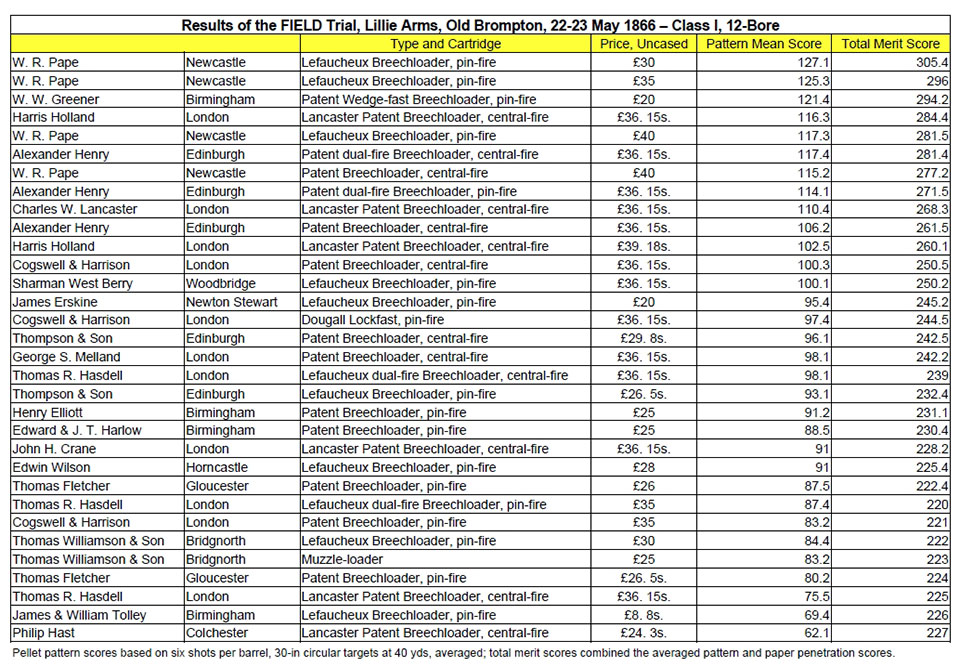
All guns performed well, and while the Tolley gun scored second-lowest in the aggregate, a closer look at the numbers shows variability among the competing guns, with some individual shots in the Tolley gun scoring near or alongside the best-performing entries. The top-scoring guns were pin-fires with laminated steel barrels, by William Rochester Pape (1st, 2nd and 5th place) and William Wellington Greener (3rd). In 4th place was a central-fire gun on the Lancaster patent with drawn-steel barrels, built by Harris Holland.
It was also noticed that the eight top-performing guns used the coarser nos. 5 and 6 powders, and the bottom thirteen (including the Tolley gun) used the finer-grained no. 3 powder, suggesting that the scoring for pattern and penetration might have shown a narrower range had all contestants used the coarser powders.
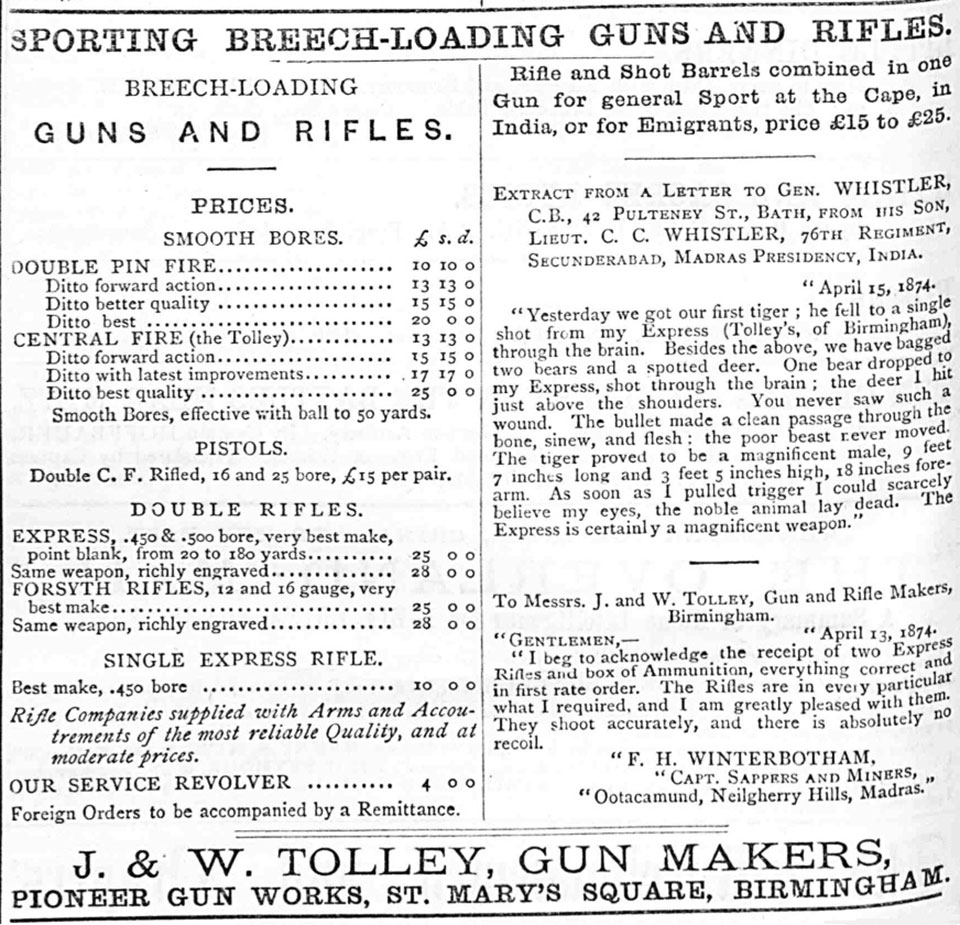
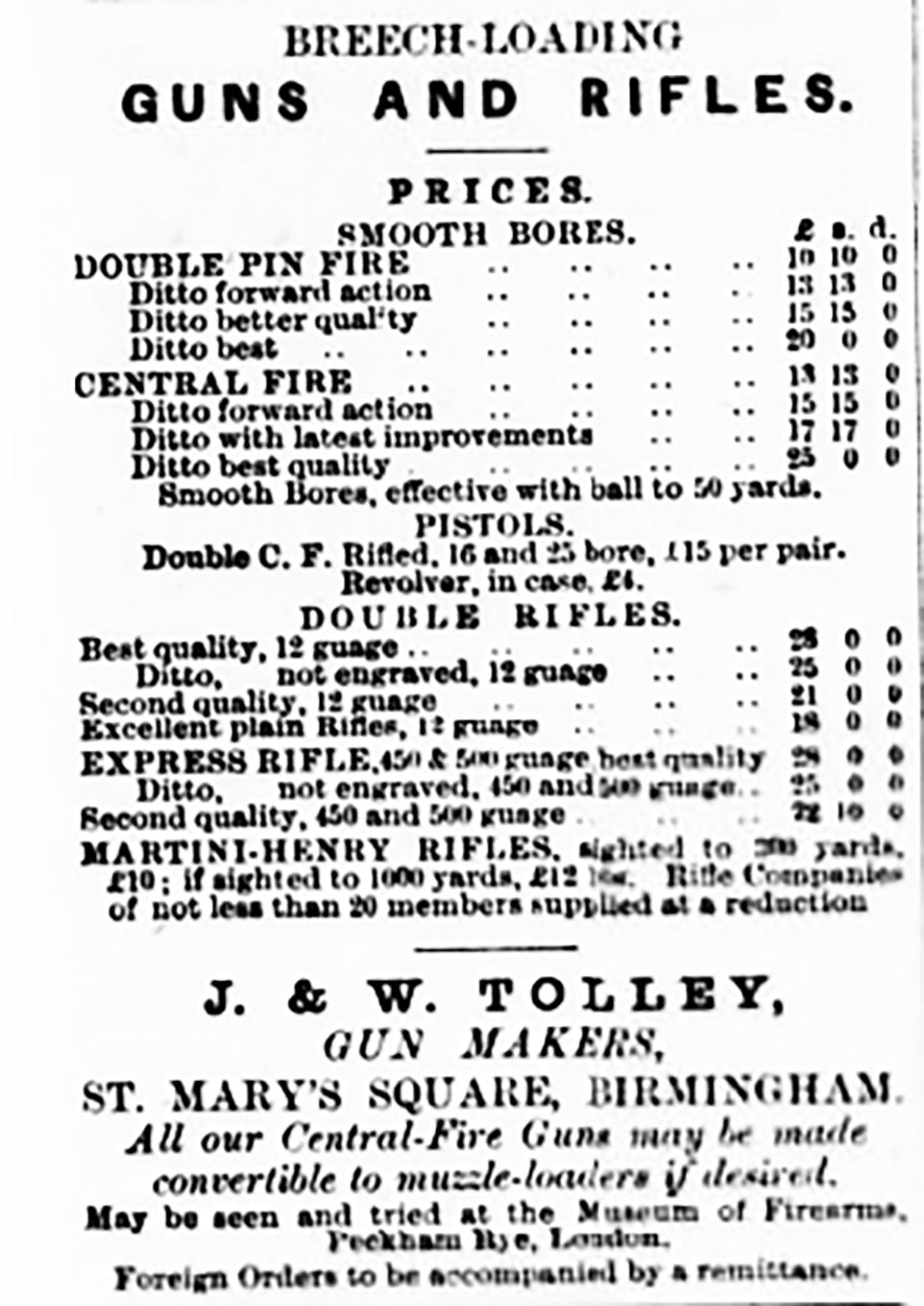
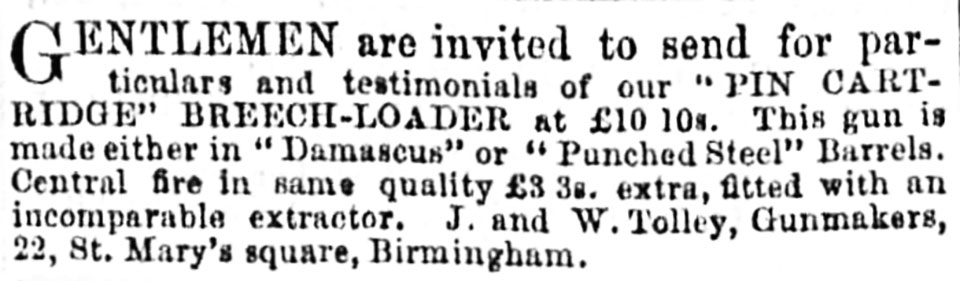
For a frugal, sharp-eyed analyst of the results, the Tolley gun was worth considering, as it did well at a fraction of the competition's price. The earliest account of a Tolley breech-loader I am certain of is the 1866 trial gun. I presume the Tolley firm made them earlier, but evidence is lacking. The trial would have generated publicity and orders, and by mid-1867, the price of the basic Tolley pin-fire game gun had increased to £10. 10s. It was available with damascus or ‘punched steel’ barrels (the latter term may refer to machine-forged barrels); this was still about half the price of comparable guns.
The price remained at that level throughout its promotion. The last advertisement for the pin-fire gun in The Field newspaper appeared in the 23 March 1872 issue. The Tolley brothers continued advertising their bargain pin-fire in newspapers aimed at expatriate readers, such as Broad Arrow, Volunteer Service Gazette and Military Dispatch, Army and Navy Gazette, Home News for India, China and the Colonies, Homeward Mail from India, China and the East, and foreign newspapers such as the Indian Statesman.
The promotion continued until February 1876, after which all J & W Tolley advertisements stopped mentioning pin-fire guns. In the absence of the makers’ records, a run of at least 10 years for a particular model of pin-fire gun makes it difficult to age a gun. Often, a narrow manufacturing ‘window’ can be determined by features and styles that came and went quickly as technology advanced and tastes changed. Tolley had little incentive to change anything on their entry-level gun, especially if keeping to the same pattern kept production costs down.
There is even the possibility that the £10. 10s. gun was what we define today as a loss leader, where the selling price is at or below the cost of production, to attract customers who can be enticed to purchase better (and more profitable) guns. I can’t say for sure, but keeping the same low price for at least 10 years suggests the possibility.
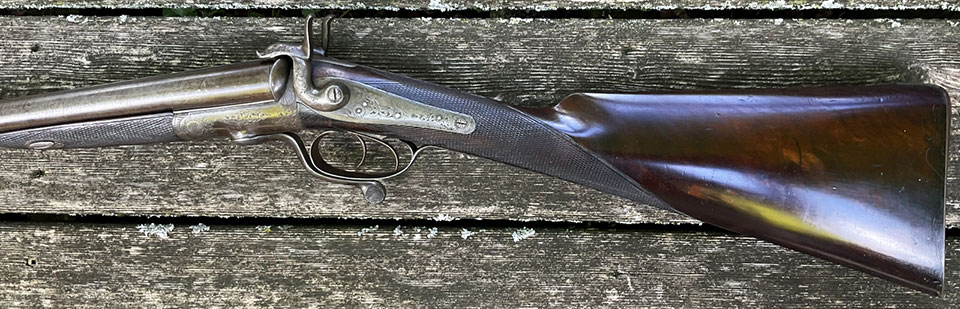
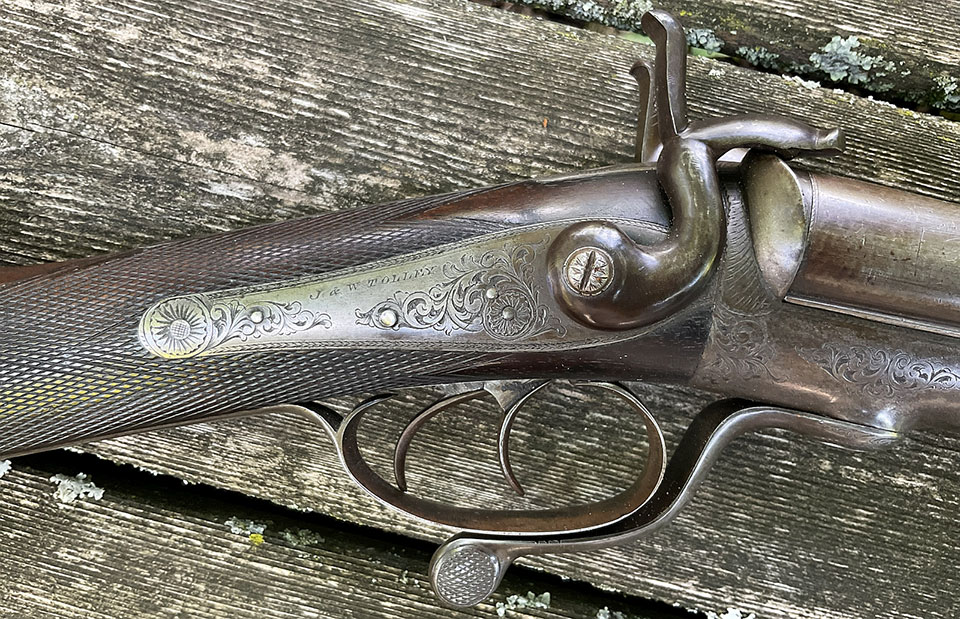
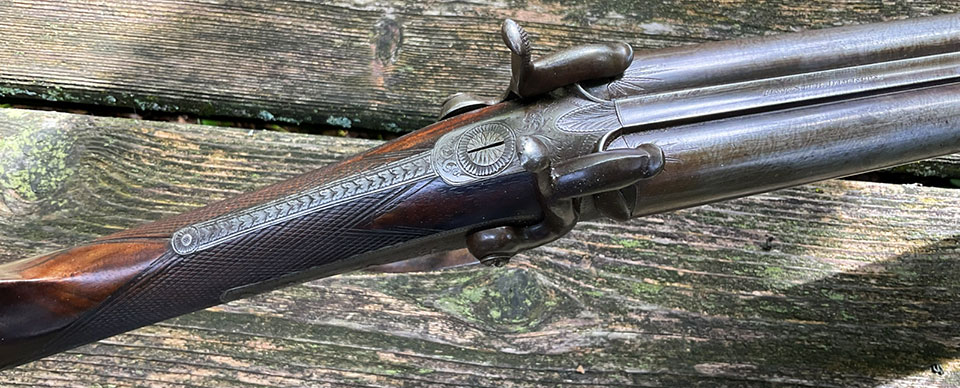
The lack of examples in collections also makes me wonder how successful Tolley’s strategy might have been, though guns may have ended up scattered throughout the Empire. The example shown here did turn up in Canada. It is J & W Tolley’s rotary-underlever pin-fire, in 14-bore, representing what was offered between at least 1866 and 1876.
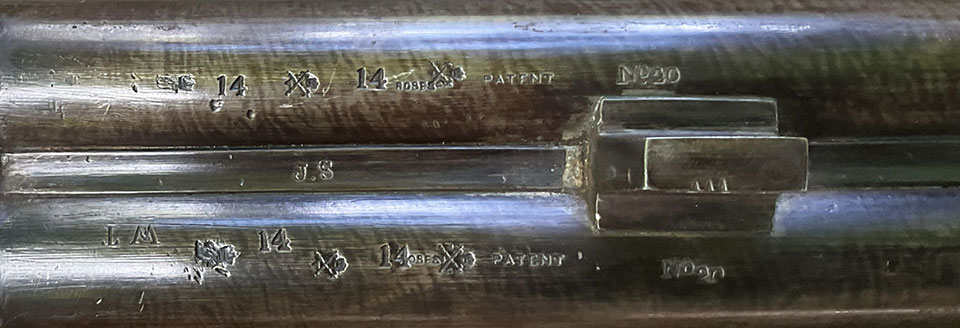
At the time, the more expensive options had ‘forward actions,’ which I interpret to mean snap-actions of a sort. It lacks a serial number, but I’ve never encountered another, so I can’t say whether all of Tolley’s entry-level guns were similarly unnumbered. It has 30-inch laminated steel barrels with Birmingham proofs, and the machine-forged barrel tubes are stamped ‘Roses Patent No. 20,’ indicating they were made by the Rose Brothers of the Hales-Owen Mills & Forge, located in Halesowen, Worcestershire.
The top rib lacks a street address but has ‘Fine Stub Damascus’ inscribed on it, and the back-action locks are signed ‘J & W Tolley.’ The gun may have been produced on a Birmingham workbench at Tolley’s instruction, though the gun is stamped with the initials ‘WT,’ suggesting at least part of the gun may have been crafted in-house. There is also a barrel maker’s mark, ‘JS,’ possibly identifying Joseph Smith of 27/28 Loveday Street as the assembler of the Rose Brothers tubes.
other Birmingham makers were putting out inexpensive pin-fires with much less detail and finish
The gun has simple but attractive foliate scroll engraving, starburst detailing at the pin-fire apertures, a well-figured stock, and a horn-tipped fore-end. The only obvious cost-cutting measures, other than the machine-forged barrels, are the ubiquitous double-bite screw grip action and the lack of a silver stock escutcheon.
As to the date of manufacture, it could be any time between 1866 and 1876. By the 1870s, other Birmingham makers were putting out inexpensive pin-fires with much less detail and finish and with cruder engraving, so I’m guessing this may be an earlier gun. For being a fourth-quality gun and one of the cheapest on the breech-loading market, it is surprisingly well-made and finished.
Period repairs might hold clues as to the use of less durable materials: one hammer has been replaced, and some work has been done on one of the locks, perhaps a replacement of a mainspring and tumbler. Despite its long life, it is in good working order with clean bores, and it weighs 7lb 2 oz.
When new, it would have been quite a handsome gun, and even today, placed alongside examples of second- and third-quality pin-fire game guns, nothing distinguishes it from similarly actioned pieces. I can only imagine the consternation of other gunmakers back in the day, who charged twice the price for essentially identical game guns.
NOTES
I wish to thank the Internet Gun Club database for its information on the firm of J&W Tolley, and The British Newspaper Archive as the source for the advertisements.
Stephen Nash
27 August 2026
TOLLEY_Illustrated Sporting News and Theatrical and Musical Review 28 March 1868.jpg
Illustrated Sporting News and Theatrical and Musical Review, 28 March 1868
Source: The British Newspaper Archive
TOLLEY_Home News for India, China and the Colonies 24 May 1872.jpg
Home News for India, China and the Colonies, 24 May 1872
Source: The British Newspaper Archive
TOLLEY_Week's News (London) 13 June 1874.jpg
Week's News (London), 13 June 1874
Source: The British Newspaper Archive
Published by Vintage Guns Ltd on (modified )