Looking at guns of the Victorian era with a few miles on the clock, it is hard to see or imagine accurately, what they were originally like.
Those restoring guns often wonder what the original finishes were; for only knowledge of the correct original finish gives them any chance of restoring guns in a manner that is appropriate.
Occasionally a vintage example is found in such exceptional condition that it imparts that knowledge and helps us see and feel exactly what the masters of old intended their guns to be.
This is just such a gun.
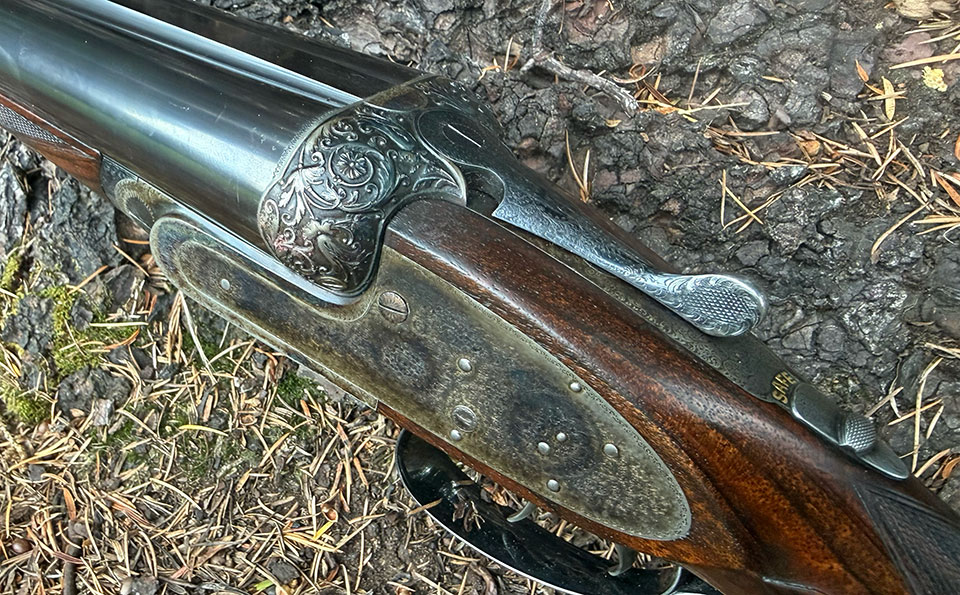
Readers of the Vintage Gun Journal will be aware immediately that it is a Purdey. The house style is so familiar to students of the gun that it soon becomes imprinted in the mind's eye.
Not only is this gun a beautifully preserved example of Purdey's work, it is an exceptional individual build, which stands out from the norm in several important ways.
What is familiar is the mechanism. James Purdey the Younger adopted the spring-cocking, self-opening sidelock that Frederick Beesley introduced to him in 1880. Purdey was convinced that this brilliant invention, which was unlike anything else then available, represented the very best of the hammerless gun actions then rapidly taking over from the hammer guns that were still the norm.
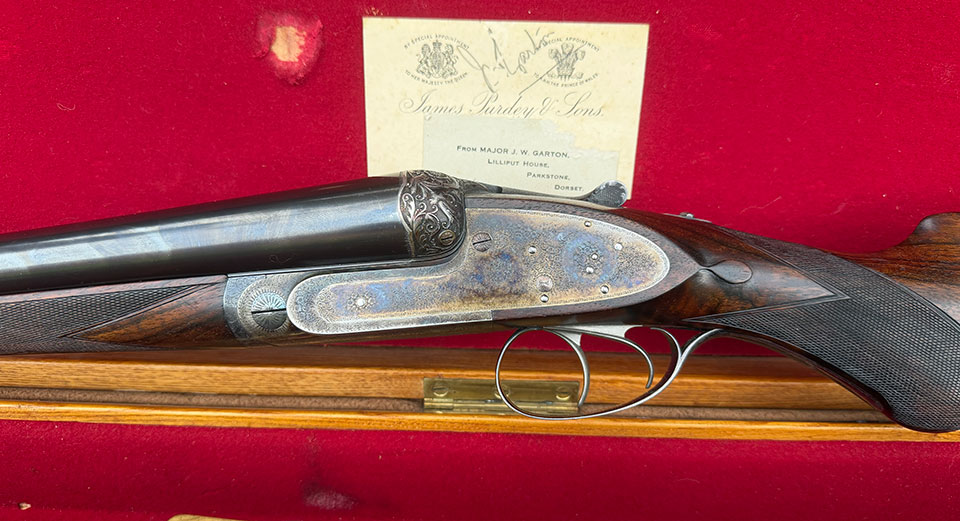
Beesley's patent utilised the mainspring in both the cocking and firing of the lock, but also had it applying presure to the underside of the barrels, forcing them off the action when the bolting was removed, via the operation of the lever.
Purdey's gun jumped open forcibly, making one-handed operation possible and reliable, and loading correspondingly faster.
James Purdey the Younger bought Beesley's brilliant invention and it became Purdey's signature gun. It remains so today, one hundred and forty six years later.
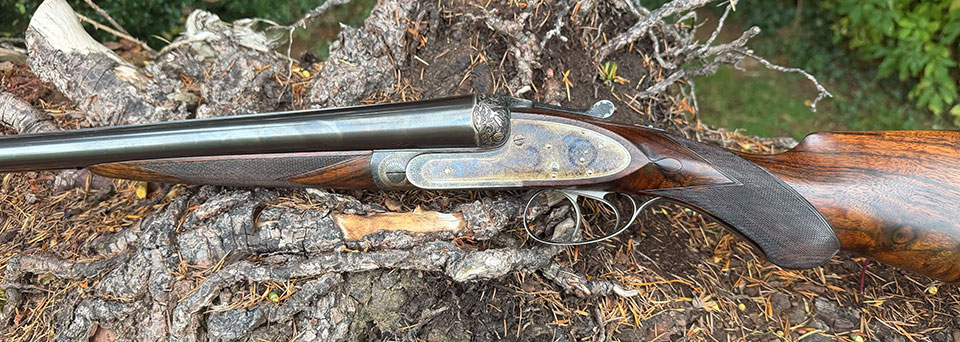
The gun pictured here is a classic Purdey but it is not a normal Purdey. It was made for the Paris Exhibition of 1898. By that time, the design had proven itself popular among the British elite who could afford the very best new guns and Purdey's standard of build quality was exceptional and appreciated.
Purdey added Wem patent ejectors to Beesley's action and thereby created the gun that would dominate the best shooting estates of the UK for the next seventy years.
the British elite could afford the very best new guns
However, like many of his contemporaries, Purdey was aware of the need to extend his sales to other markets. London's top gunmakers then already had important foreign accounts, with Indian princes and European nobility frequently apearing in the ledgers as customers.
Exhibitions had been popular during Victoria's reign. The 1851 Great Exhibition in London's Crystal Palace, embodied the Victorian ideal and promoted science, discovery, invention and the ingenuity rampant during this febrile age of change.
Other cities followed the lead that Victoria's husband, Prince Albert, had started in 1851 and similar exhibitions became popular events around the world.
The 1898 Paris Exhibition gave Purdey a chance to show off his peerless gunmaking quality and champion the hammerless gun that had become his signature.
He tasked his factory to produce a gun worthy of exhibition.
The term 'Exhibition Grade' is used frequently today by gunmakers and collectors but this is an actual example of a gun made for the purpose of exhibition to the public to show how truly exceptional this gunmaker's work could be.
When exhibiting something quite well recognised, it helps draw attention by making it unusual in some manner. Rather than displaying a normal game gun of the period; perhaps a 6lbs 10oz gun with 30" barrels, Purdey opted for something a little more dramatic.
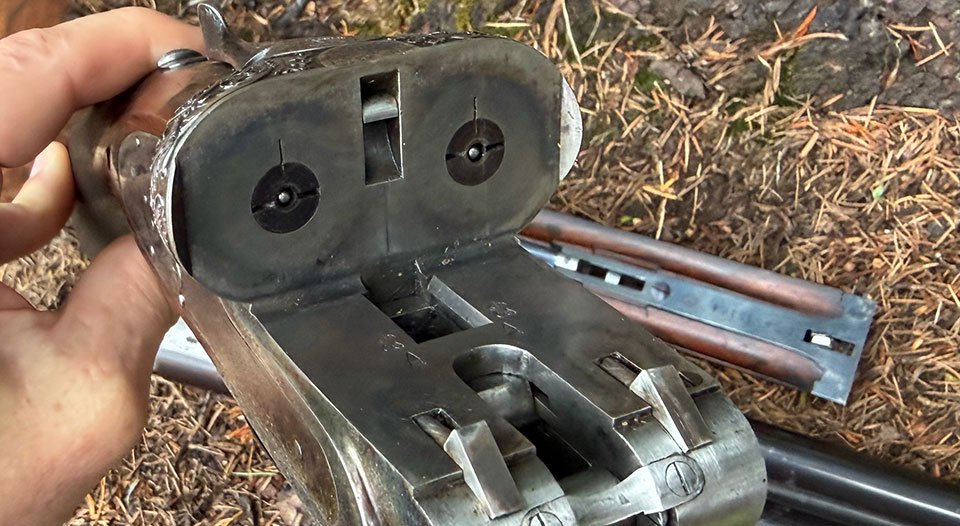
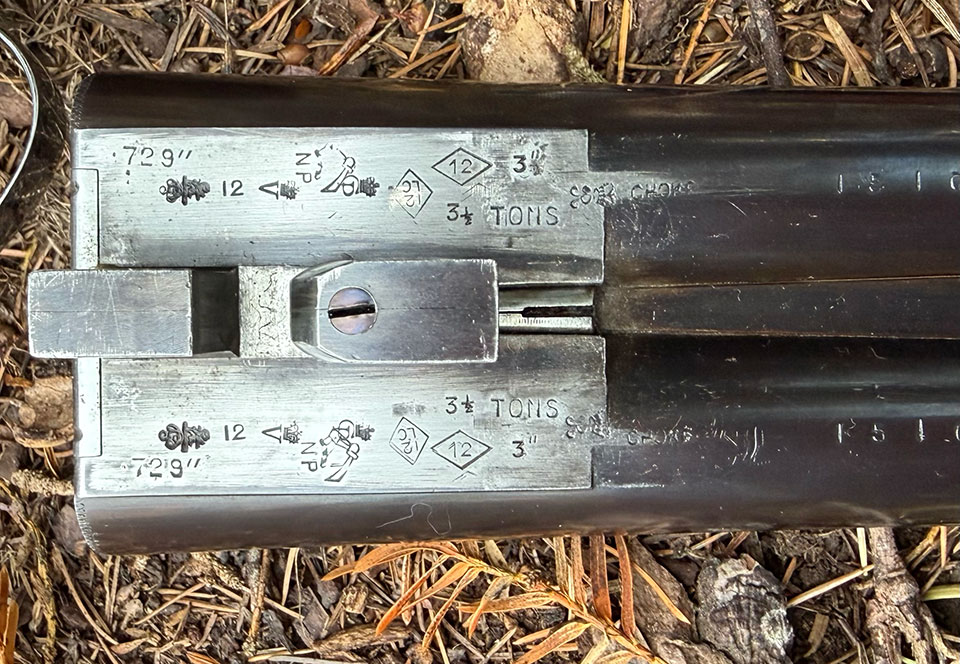
This is a big gun, though it feels lighter and more reactive in the hands than its dimensions suggest it should. It weighs a hefty 7lbs 13oz, it has 32" barrels and they are chambered for three-inch cartridges. The action is a little larger than usual, it has side-clips to the fences and a hidden, Purdey-patent, third-bite to add extra security to the bolting system.
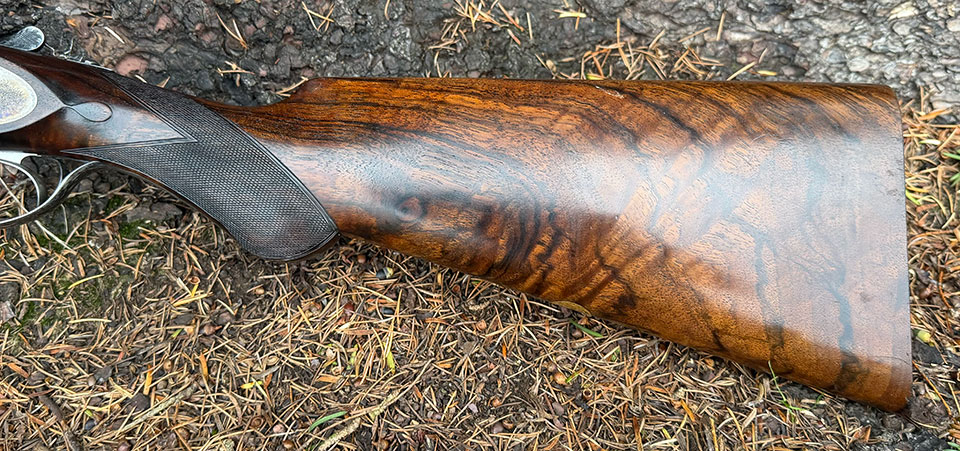
The stock is beautifullly proportioned, with an elegant semi-pistol hand. Today's customers, with their demand for 'super deluxe' walnut might think the blank chosen here a little underwhelming. It is well-figured, with contrasting black, amber and gold tones but it is not the type of wood a 2026 gunmaker would put on an exhibition gun.
woodowrk could stand up to hard seasons and inclement British weather
That illustrates how times have changed. Purdey's Victorian customers were very busy shooters. Thy expected their guns to work for years and soak up a lot of hard use. It was imperative that the woodowrk could stand up to hard seasons and inclement British weather without causing trouble.
One quickly loses appreciation for the beauty of any mechanical object when it ceases to work reliably. Purdey chose wood that was attractive but which would also give good service.
Then there is the concept of the British aesthetic of refined, perhaps restrained, excellence. The aristocracy which bought and used Purdey's guns represented a sector of society very much confident in it's own skin. Form and function had to combine seamlessly. Nothing useless can be truly beautiful and an unreliable gun is useless.
The beauty is embodied in the utility, the grace of form, the stylistic balace, the perfection of fit and finish. Indian princes may have ordered plenty of gold-inlaid, even jewel encrusted, sporting arms for their collections but the British preferred quiet, tasteful perfection.
the British preferred quiet, tasteful perfection
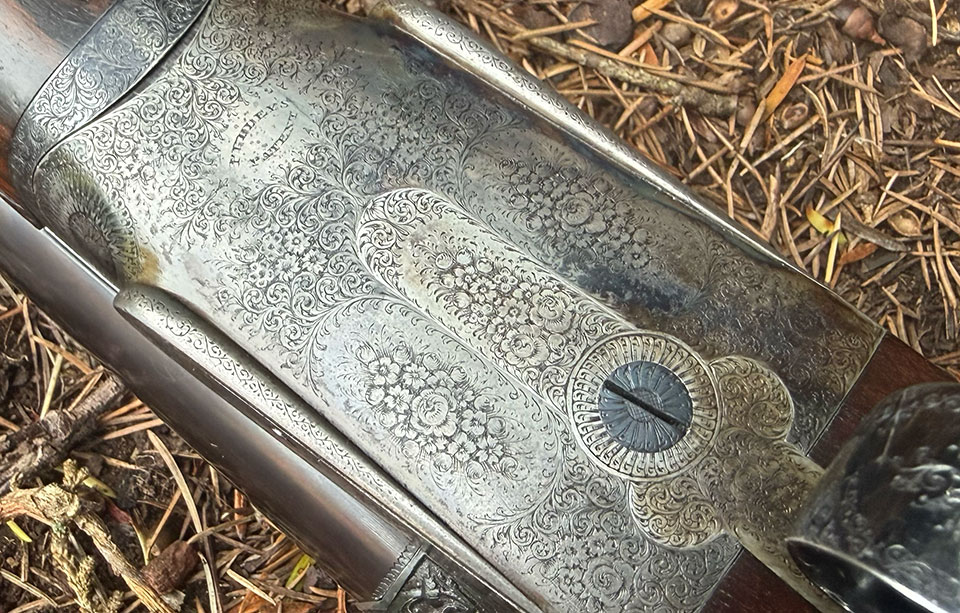
The mind of James Lucas created Purdey's 'standard fine' house style of engraving pattern. The familiar bouquets of roses and scrolls in the layout seen here is classic Purdey. Lucas was, at the time, Purdey's head engraver and he invented this pattern specifically for the Beesley patent gun.
Lucas himself was given the task of engraving the exhibition gun and he has excelled himself with his full-coverage, perfectly executed, fine scrolls and bouquets of roses. The fences, however, are exceptional. They are reminiscent of the work Barre did on a few special Purdey guns but the records mention only Lucas as the engraver.
I wonder if Lucas did the fences himself or could Barre have been used for this purpose? If it was Lucas, it shows just how good and varied his skills were.
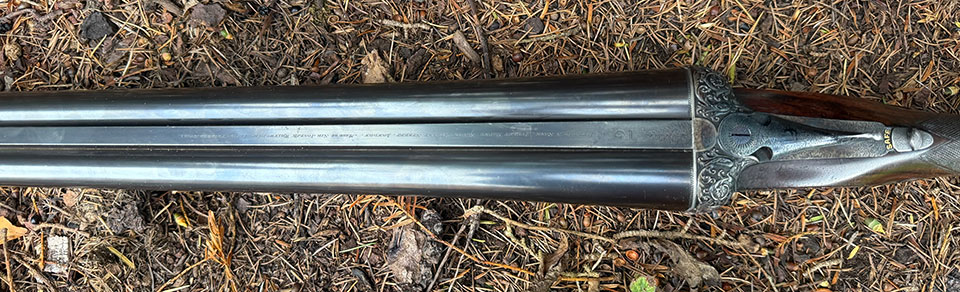
Not only do the case colours remain un-worn on this exceptional gun, the original blue shines warmly on the guard and other furniture items. The engraving everywhere remains crisp and sharp. Why it remains so original and why it was was never used to any great extent is a mystery.
We are fortunate that it has been saved in a state so close to the one in which it was originally displayed.
Time has faded the wood finish perhaps, which is inevitable, but the perfectly cut drop-points and sharp chequer panels are examples to us all of the elegance of late Victorian stocking and finishing.
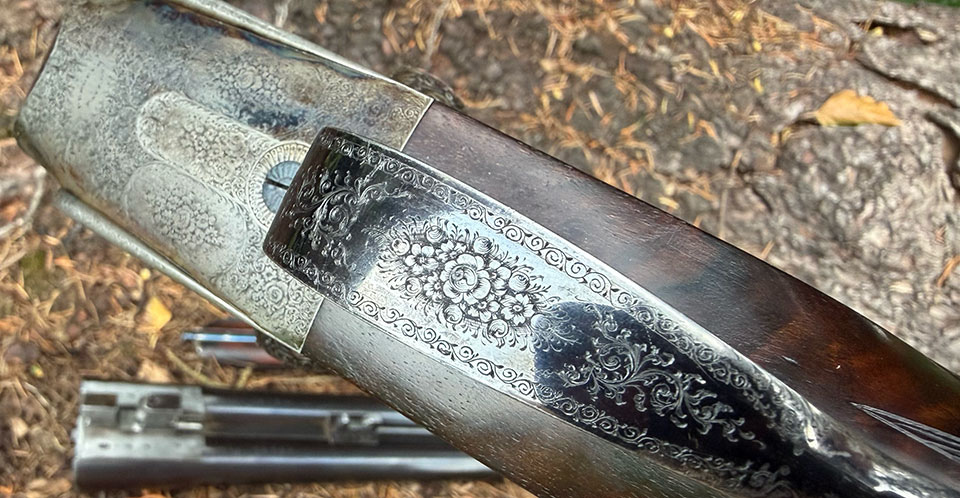
Dealers often talk of collector-grade or shooter-grade inventory. This is most definitely in the collector-grade category.
However, before it goes anywhere, I am defininitely going to take it to a suitable peg on a nice dry day this season and experience it in action, where I expect its long, fully-choked barrels to bring down one or two very high pheasants. They will remain in the memory bank forever, as will this fabulous example of British gun making at the very peak of its powers.
Published by Vintage Guns Ltd on (modified )