It is sometimes mistakenly assumed that the demarkation of eras in firearms development happened in clear step-changes.
In fact, new inventions often took several years to gain acceptance and even longer to become dominant. This is true of the change from muzzle-loading to pin-fire breech loader, from pin-fire to centre-fire and from hammer guns to hammerless guns.
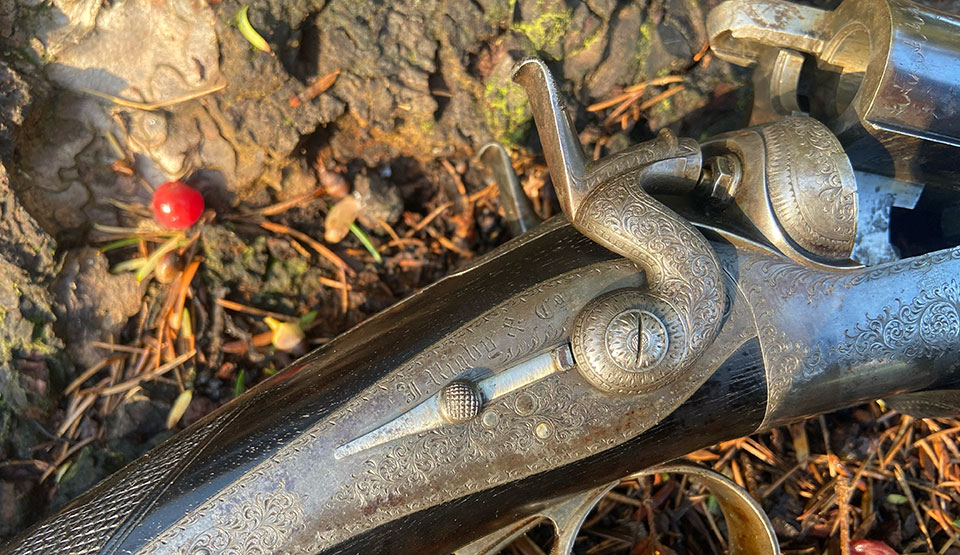
With regard to the huge numbers of different levers and bolting mechanisms patented between 1852 and 1900, it is likewise true that there was no uniform move from one to another.
One of the earliest and most effective mechanisms for holding the breech and barrels together on a breech-loader is the Jones rotary under-lever and screw grip, or ‘lever over guard’ as many gunmakers’ record books refer to it.
patented in September 1859 and given No.2040
It was patented in September 1859 and given No.2040 of that year. Although it is an inert action, requiring the operator to manually close and lock the rotary screw-grip, which pulls the barrels down tightly onto the action flats, it is very strong and very reliable.
Its only real shortcoming is speed when compared to contemporary snap actions like the one Daw introduced in 1861 when he launched Schneider’s ‘central-fire gun’ onto the market. We know this today as a ‘snap under-lever’.
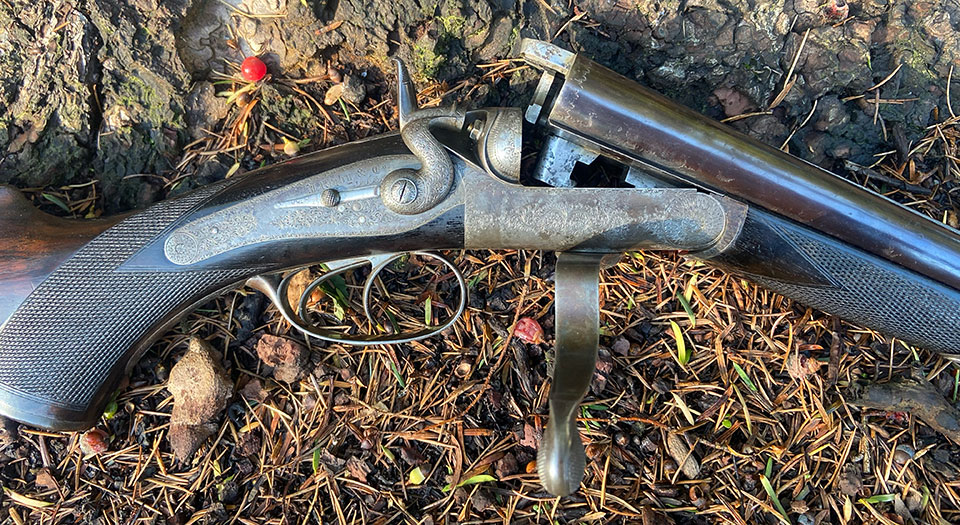
Some might argue the Jones lever looks less attractive than a gun with a side-lever or top-lever. That is a matter of opinion but the gunmakers and the public of the late 19th century certainly seem to have considered the latter the preferable option for ‘modern’ guns.
John Rigby, like every other gunmaker, used the Jones patent widely in the production of his hammer guns and rifles. Here we have just such a rifle, made in .450 black powder express. It was completed in August 1890 for a Capt. Oswald as a ‘double .450, double-grip, vertical bolt, best outside hammers’ .
Rigby refers to Jones’ patent as a ‘double-grip’
Note that Rigby refers to Jones’ patent as a ‘double-grip’ in this instance. In other entries he refers to it as a ‘Le-Faucheaux’, which it is not. As mentioned earlier, a Jones lever on a Rigby hammer gun is not unusual. What is unusual is the teaming of the Jones mechanism with another, for which Rigby is much better known; The Rigby & Bissell vertical bolt, which is perhaps more widely recognised as the ‘rising-bite’.
I have never before seen one with a Jones lever...
John Rigby and Thomas Bissell were the same age and collaborated a great deal. In 1878, when the mechanism was patented, both men were fifty. I have seen plenty of ‘rising-bite’ Rigbys with top-levers, with side-levers and with snap under-levers. I have never before seen one with a Jones lever. It is the 402nd action made using the Rigby & Bissell patent No.114.
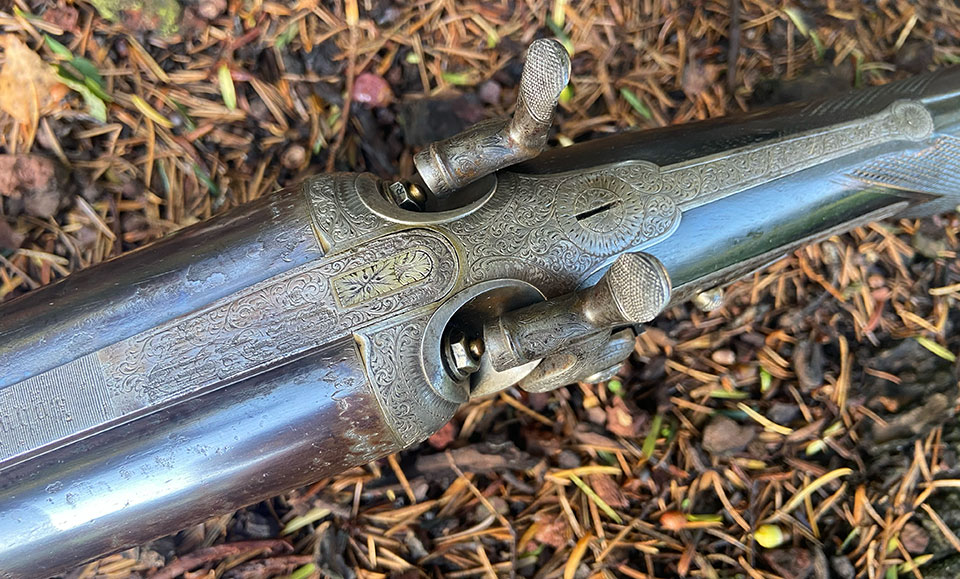
As the rotary under-lever is moved, it not only releases the screw grip, it also performs a camming action on the vertical bolt, withdrawing it from its place at the back of the pillar in the standing breech into which the cut-out in the rib extension slots. That action frees the barrels to fall and the gun will open for loading.
The rifle is a best quality hammer rifle with bolted back-locks and the action and stock are in good order. The barrels, however, are badly rusted externally and have been welded and struck before re-blacking but they remain rough. The bores have visible rifling but they are worn.
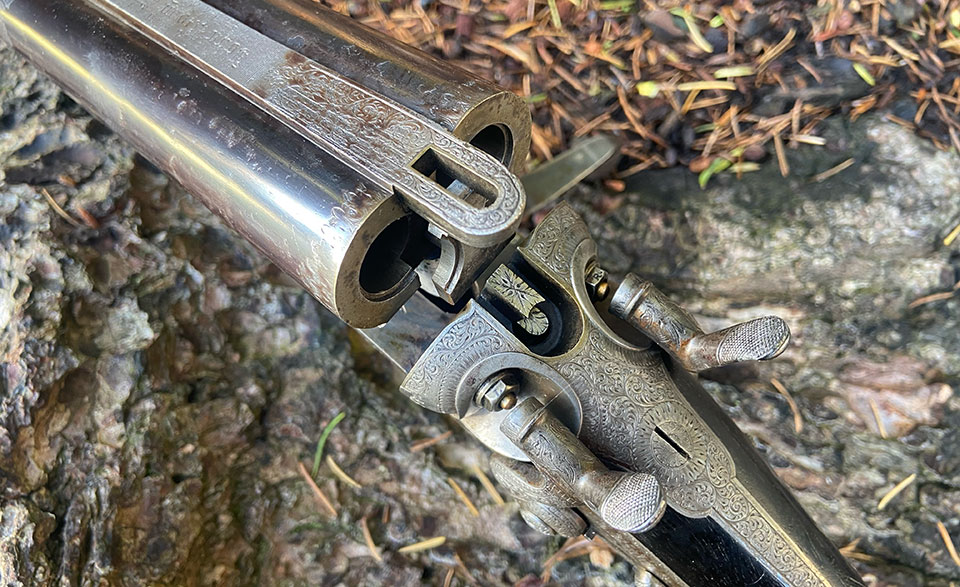
The unusual application of these two very strong locking mechanisms in one rifle is interesting. 1890 is quite late for this kind of anomaly. By this time the gun trade had Purdey’s double under-bolt (the mechanism most commonly used alongside the vertical bolt) and the Scott spindle and top-lever combination, which, as a trio of patents, formed the most widely favoured format for side-by-side sporting guns (as is still the case today).
In fact, to put this hammer rifle into perspective, the world had been using the Purdey/Beesley self-opening side-lock ejector for a decade when it was made, underlining the point made at the start of this article, that not everyone was in lock-step as the major developments in gun-making took place.
they proved extremely robust and effective.
Untold numbers of black powder express double rifles were made with simply the Jones patent action and they proved extremely robust and effective. It is very arguable that the addition of a third grip, in this case the vertical bolt, was superfluous.
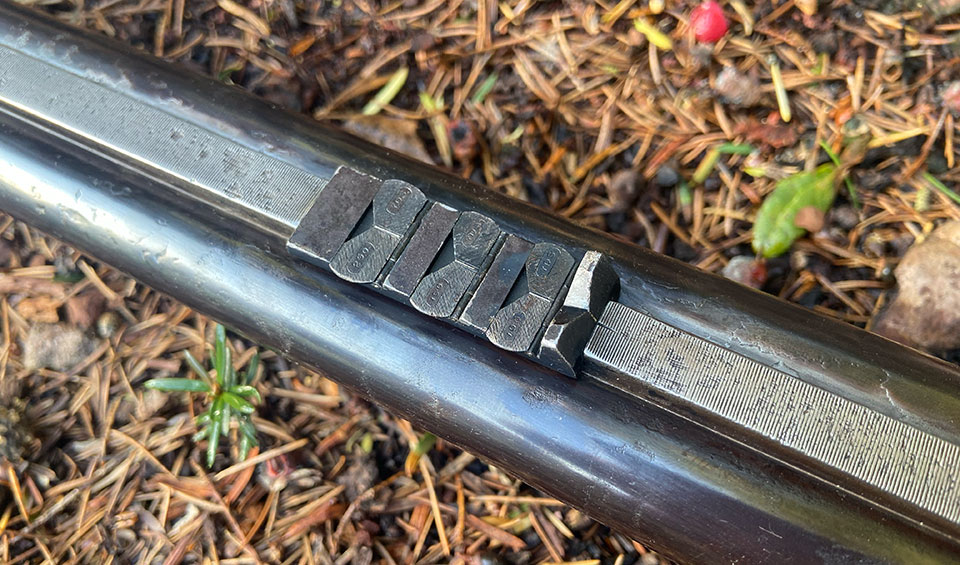
However, its efficacy cannot be argued. Just how many were made this way I cannot say for sure. Further research in the Rigby archives may shed more light on the subject, especially now we have the wording ‘double grip, vertical bolt’ to help us decipher the notes used by the clerk writing the information into the order book.
The mechanism still functions beautifully and the addition of the vertical bolt in no way impedes the normal operation of the Jones system. It is a beautiful combination but it arrived a little too late, at a time when the world had moved-on, towards more standardised models which were quicker and easier to manufacture.
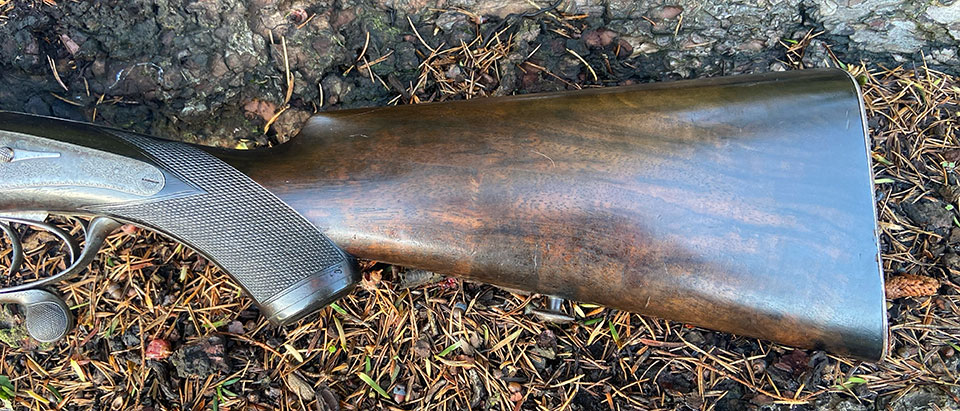
Many collectors believe (quite rightly in my opinion) that the last twenty five years of the 19th century saw a variety of design and a quality of execution in the British gun trade that has never since been equalled.
Published by Vintage Guns Ltd on