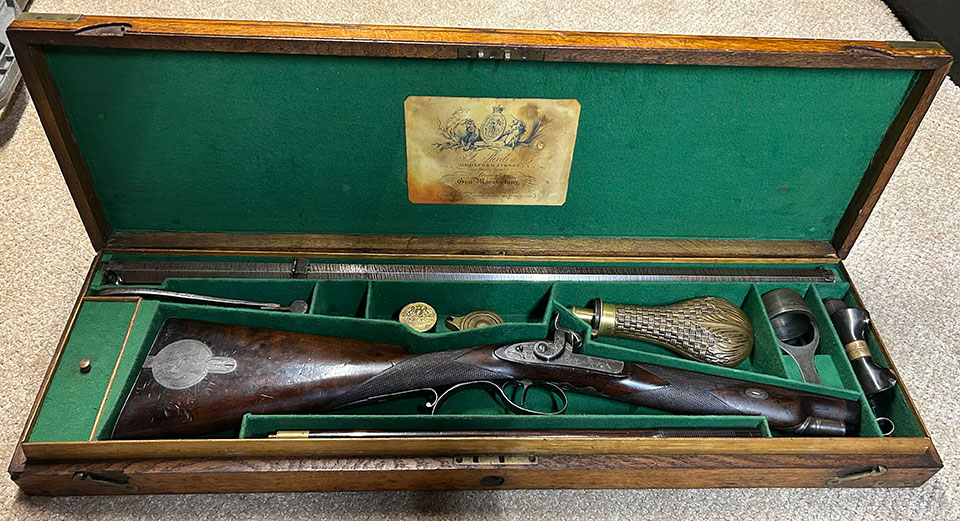
About a year ago, I had the good fortune to acquire a vintage Purdey muzzle loading rifle at auction here in Canada.
Purdey #2765 was made in 1835 as a single barrel percussion rifle of nominal 16 bore, with 30" octagonal stub twist barrel, showing Purdey's 314 ½ Oxford Street, London address.
It includes a fixed and 3 folding leaf sights from 50 yards out to a rather optimistic 200. The bar action lock has a sliding safety bolt and single-set trigger. The stock is walnut, with horn forend tip, a patchbox and steel butt plate.
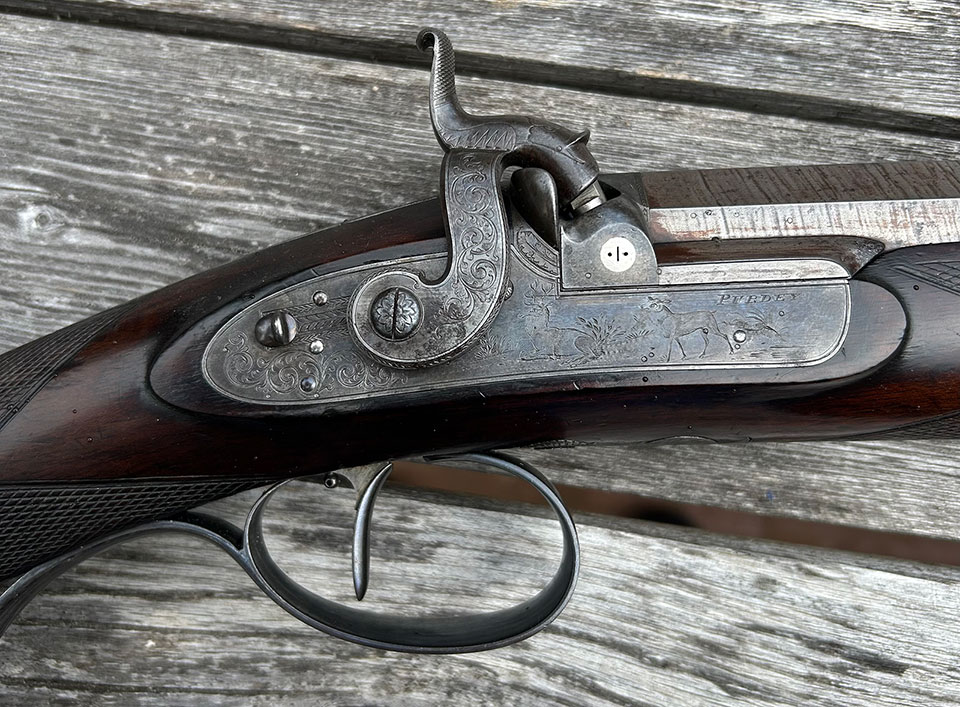
The furniture is nicely engraved in the style of the period, showing various stags, hinds, and 'tiger's mask' framed by delicate scroll work. It weighs 8 ½ pounds.
Purdey's 1835 Dimension Book indicates the rifle was made as a 16 bore, but the lands measure .715" and grooves .745".
This rifle is a pleasure to shoot. Loaded with 2 ¼ drams of black powder behind a patched ball, (and if I'm steady), it strikes the target dead-on at 100 yards using the 100 yard leaf.
The velocity is not great, since boosting the powder charge will cause the ball to 'strip' past the rifling and destroy accuracy. It was only when smaller calibre 'express' rifles appeared that higher velocities became possible.
The craftsmen and their specialized tasks involved in making each Purdey gun or rifle were recorded in the Dimension Books. A man named Abbe Robins did the ‘Polishing’ on this rifle. He worked at Purdey’s for 75 years, retiring at age 92 in 1901!
The first Henry Atkin is recorded under 'Screw'd together', 'Making off, Chequering, & Escutcheons' and 'Detonating & Finishing'. It was his son, also called Henry, who would go on to found his own gun making concern, still trading today as Atkin Grant & Lang.
It turns out that this old Purdey has an interesting provenance.
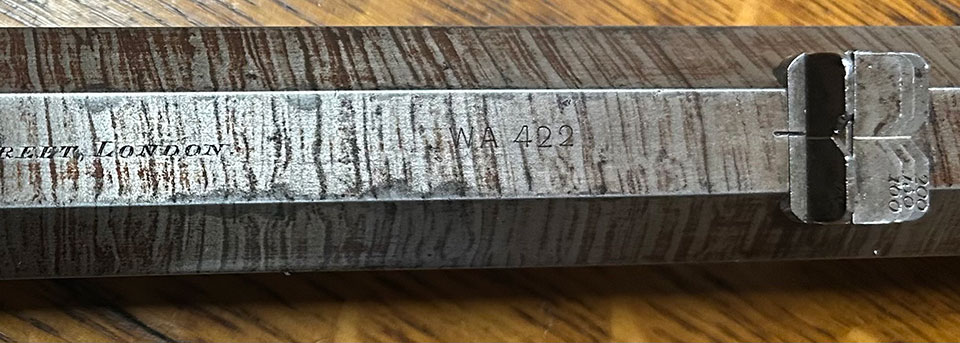
Subtly engraved on the barrel and butt plate is 'WA 422' - an Irish registration mark for County Waterford, indicating that the gun must have belonged to someone living there.
Sure enough, Purdey's Dimension Book for 1835 shows that the rifle was ordered by Henry de La Poer Beresford, the 3rd Marquis of Waterford, at a cost of just over 39 pounds.
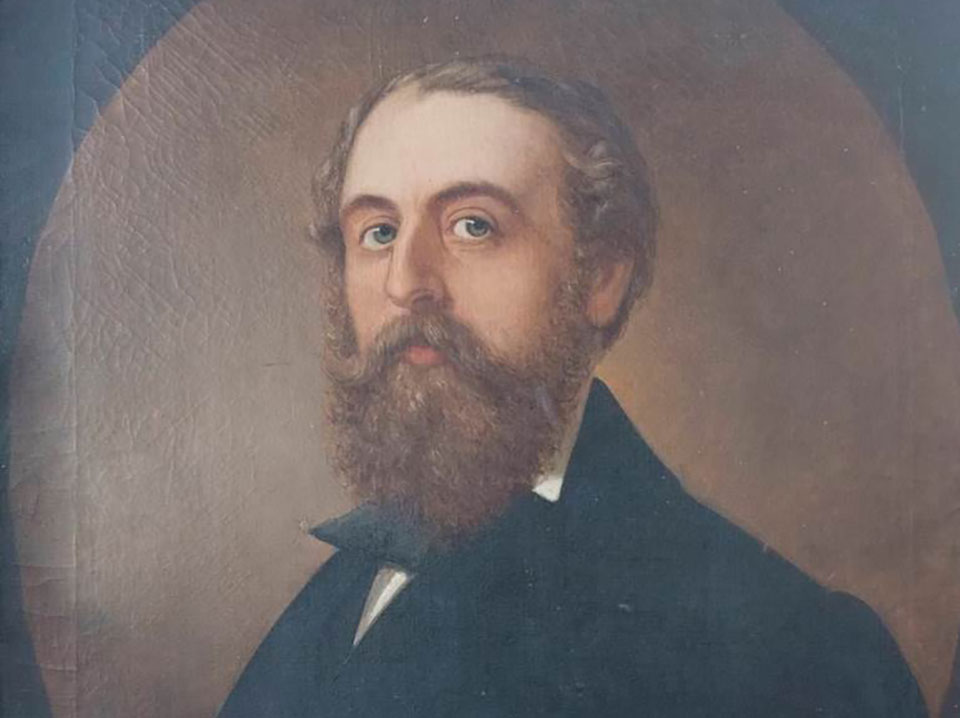
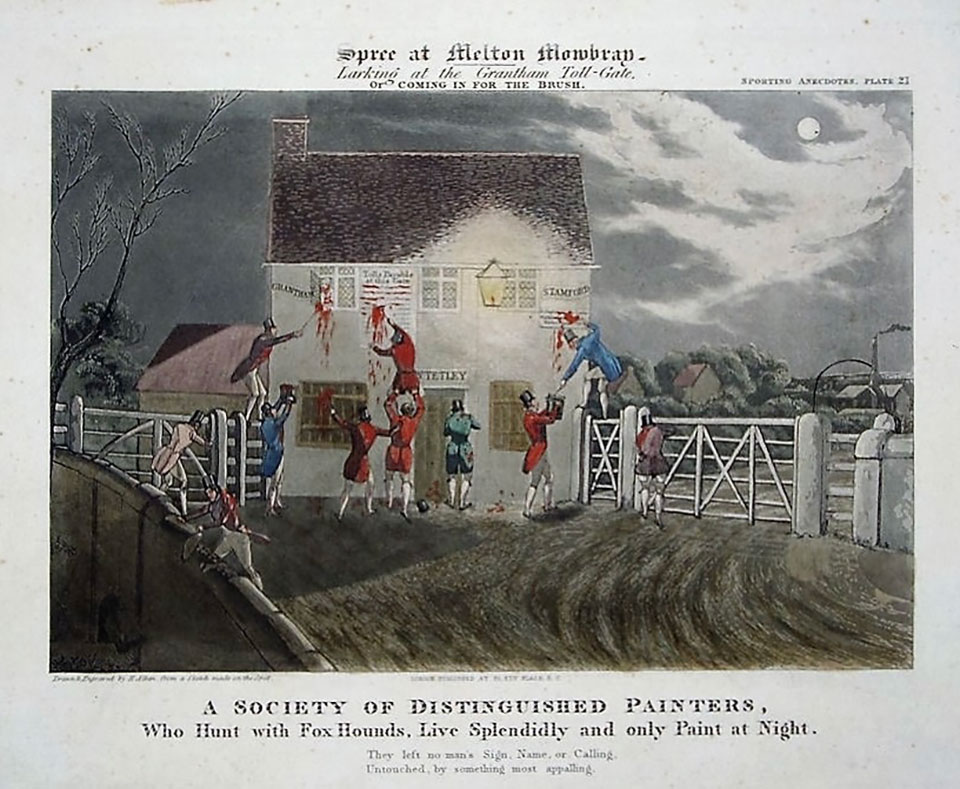
He was also known as the 'Mad Marquis of Waterford', a mischievous fellow whom some say is responsible for the expression “paint the town red' and was rumoured to be the infamous ‘Spring-Heeled Jack’ of Victorian times.
Not unlike the eccentric Scottish collector Charles Gordon, Beresford inherited great wealth and became the Marquis of Waterford at just 15 years of age. His estate, Curraghmore, still exists in County Waterford and is home to the 9th Marquis.
For more entertaining details about the Mad Marquis’ life and times, have a look at the 3 part video series from the Public Records Office of Northern Ireland (PRONI), available on YouTube.
Coincidentally, a nearby Canadian collector friend once owned a Purdey percussion double rifle that was also made for Beresford.
Henry Arken’s painting depicting Beresford’s drunken ‘paint the town red’ spree at Melton Mowbray in 1837.
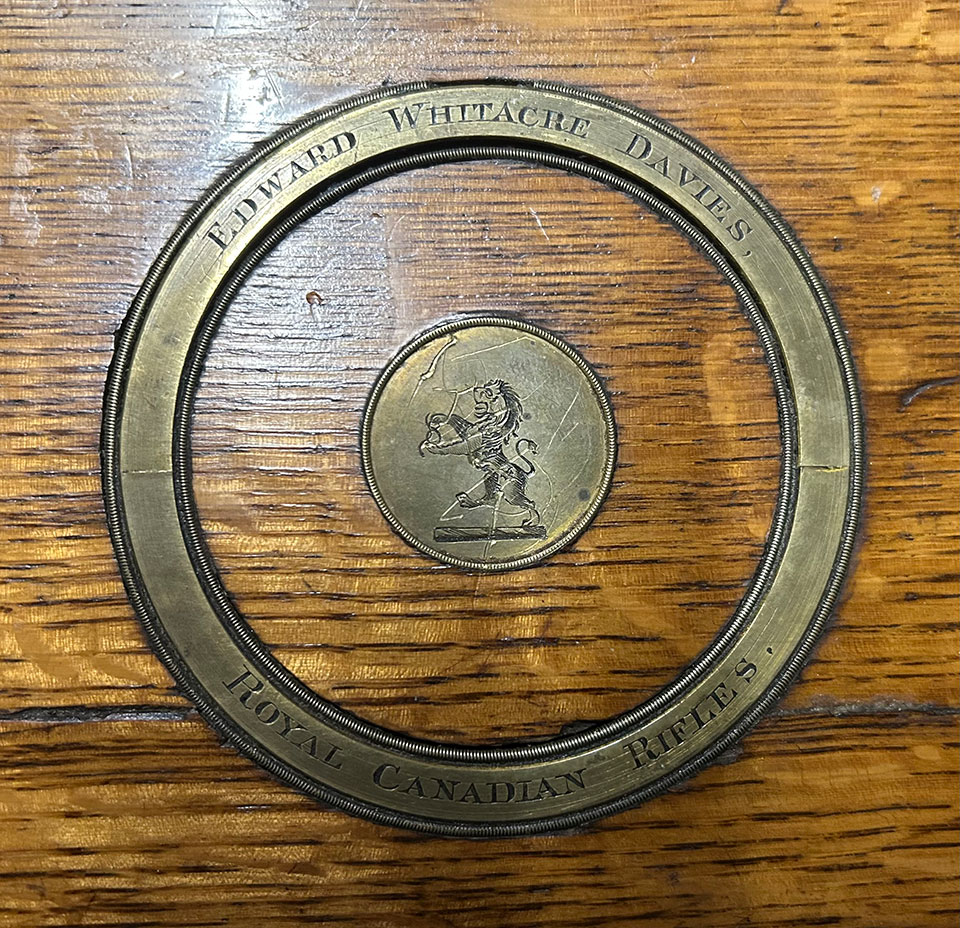
The original mahogany case has been replaced with an oak version and is engraved 'Edward Whitacre Davies Royal Canadian Rifles' on the brass carry-ring. The 'Royal Canadian Rifles' was a British regiment that existed in Canada between 1840 and 1870.
That may explain how the gun ended up on this side of the pond, but how Davies acquired the rifle from the Marquis is anyone's guess.
As it approaches its 200th birthday, this old Purdey remains in very good condition and is still capable of performing well at the range or in the hunting field.
NOTES
I wish to thank Dr. Nicholas Harlow and staff at Audley House for showing me the 1835 Dimension Book in order to learn more about its illustrious history. James Purdey the Elder would be proud!
MARK BATTEN
Published by Vintage Guns Ltd on