Everybody loves a Rigby .275 stalking rifle. Between 1897 and the start of the Second World War Rigby sold around 4,500 of these in various guises and calibres, described variously as the Mauser Sporting, Mauser Sporting Best, Mauser Sporting H.V., Mauser Sporting Magnum and Mauser Sporting Big Game, with take-down and 'light model' versions also available.
Production slowed as hostilities brewed and the last rifle sold before war broke out was a .416 'Mauser Sporting Big Game', to R. Gandrot on 6th November 1939 (No.5738).
Rifles continued to be sold during the war, but only around twenty were delivered between 1940 and 1945.
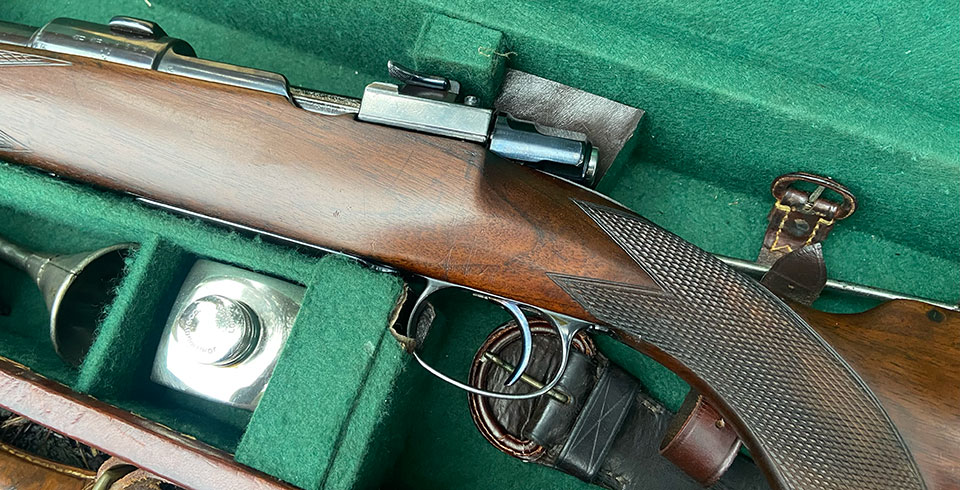
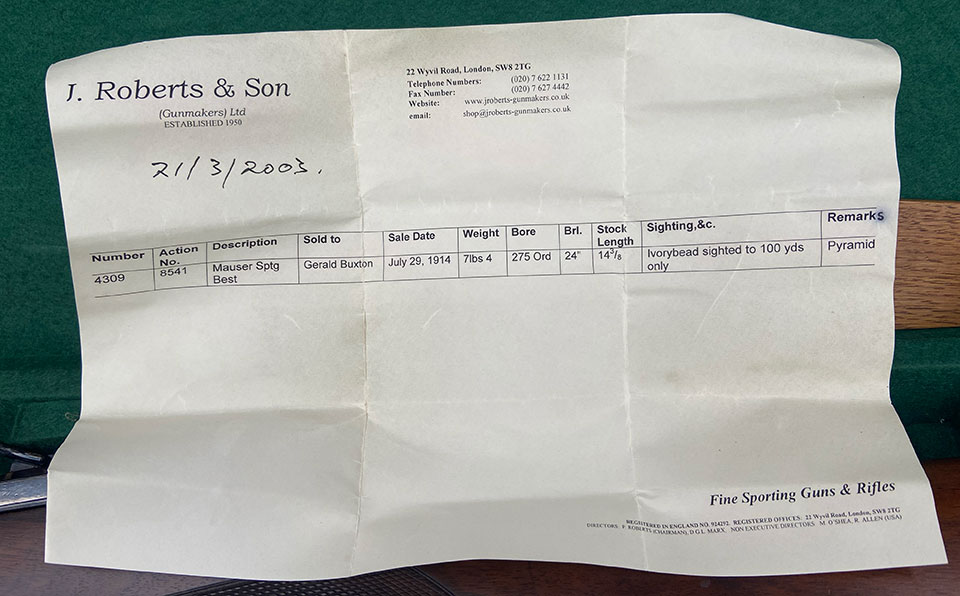
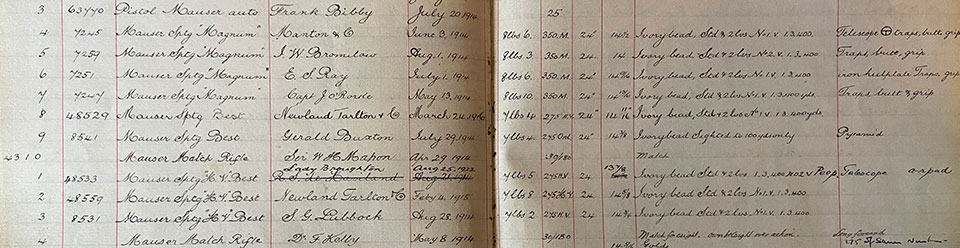
The rifle featured here is No.4309, made as a 'Mauser Sporting Best' for the ordinary .275 cartridge (not the H.V.). and sold to Gerald Buxton on 29th July 1914, just a day after Austria-Hungary declared war on Serbia, which quicky accelerated wider hostilites and grew into the Great War of 1914-1918.

The years between 1900 and 1914 had been kind to the British gun trade and Rigby had prospered. The British Empire was at its zenith and demand for all kinds of sporting guns and rilfes was huge.
The cordite-powered revolution of the period had trasformed rifle shooting and the Rigby-Mauser had been a highly successful partnership.
This rifle is, therefore, one hundred and two years old and it is no surprise that it has experienced some wear and modification. It is a credit to the mecahanical genius of Paul Mauser and the build quality that Mauser and Rigby put into making these rifles that so many of them are still in service.
A surprising number have survived in very good original order and the best examples can fetch eight thousand pounds at auction. Tatty ones might make £1,000 and the rest fill the gap in between.
Naturally, over the years, people have picked up old Rigbys and restored them, altered them to suit their needs and improved them as technology allowed.
The market has split into two factions. One, the ultra-dedicated collector, seeking only totally original, unmolested and barely used rifles. The other, taking a more practical view, buying the rifles to use and seeing sensible modification as both necessary and desirable.
If done sympathetically, they might argue, such modification delivers a classic-looking Rigby that functions more efficiently in the field.
This is just such a rifle.
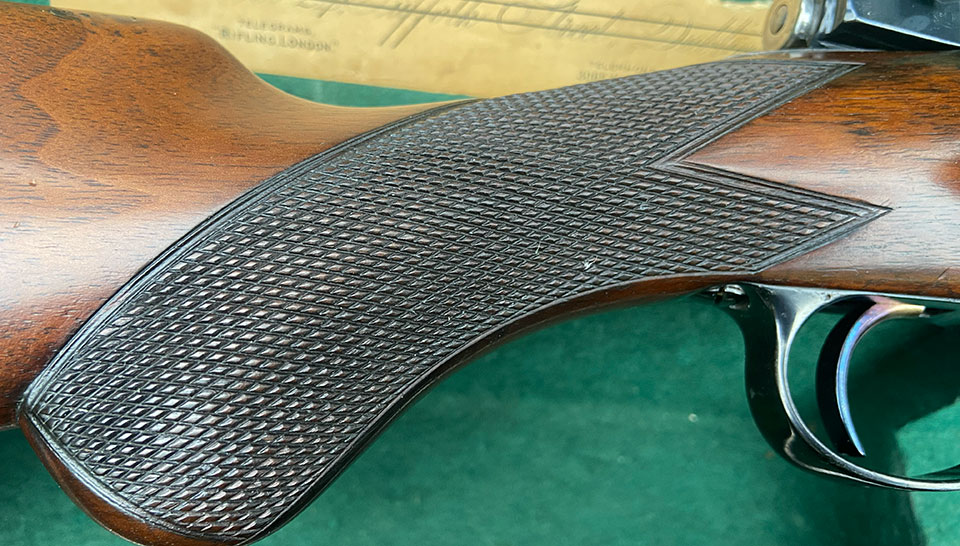
The last time No.4309 was sold, it was restored and altered by former Rigby employee Ronald Wharton. He restored the woodwork, fittted a saftety catch allowing a lower mount for the 'scope, fitted correct style 'scope mounts and a Swarovski 3-9x36 optic.
The rifle was originally supplied with iron sights only.

Like many Rigby owners, the last one sought out the provenance of his rifle by asking former Rigby chairman Paul Roberts, whose retained knowledge of the company is enormous.
At the time, 2003, Rigby was no longer trading in London, having been sold to Neil Gibson of Texas in 1997. Paul had retained copies of the ledgers and from these he was able to confirm the details of the original order.
Ron Wharton used an original Mauser trigger blade for authenticity but fitted an upgraded Timney trigger for better trigger pulls. What he produced is an authentic-looking 1914 Rigby .275, better able to perform as a modern deer stalking rifle, which it has done for the last twenty years.
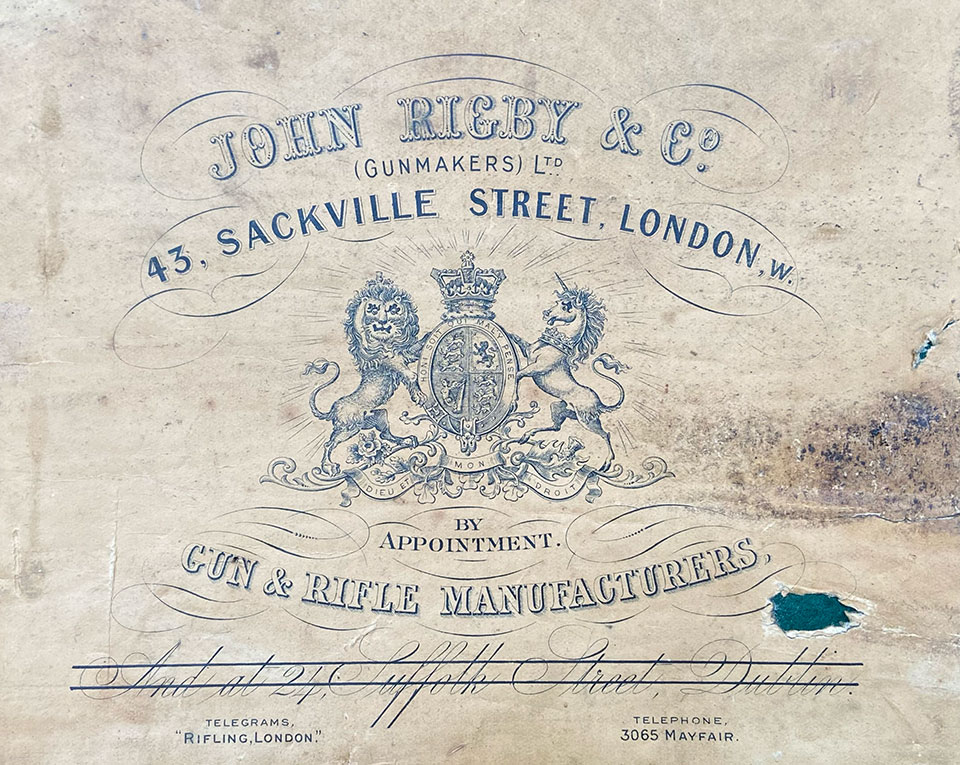
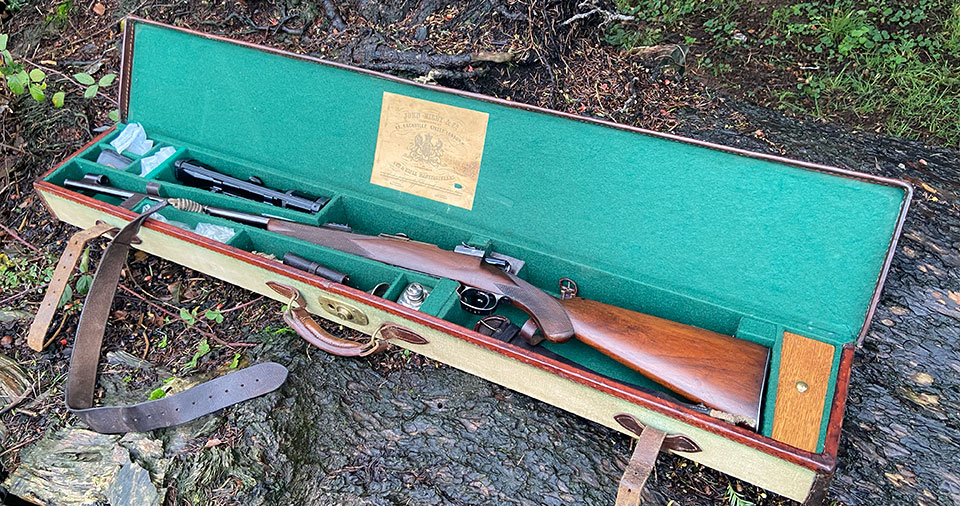
The case, constructed from wood, canvas and leather, is correct for the period and the for the rifle but the two are not long-time bed-fellows. It was made for another rifle, supplied to Lord George Brown and bears the name 'Ardour' on the exterior of the lid. Inside, the full accompanyment of accessories includes cleaning rod and jags, a traditional Rigby sling, oil bottle, 'scope, muzzle-cap and cloth.
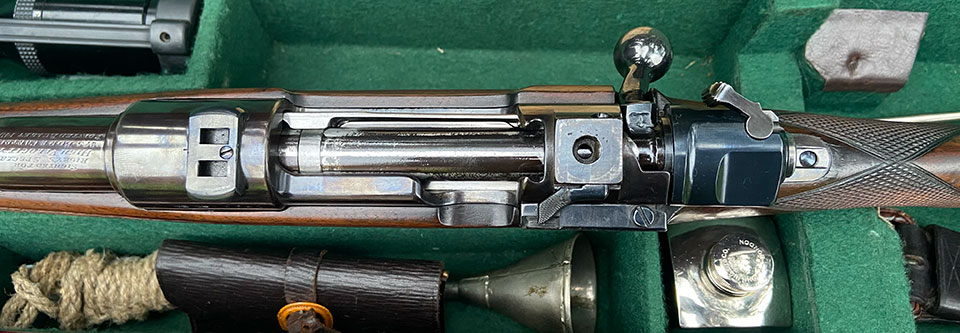
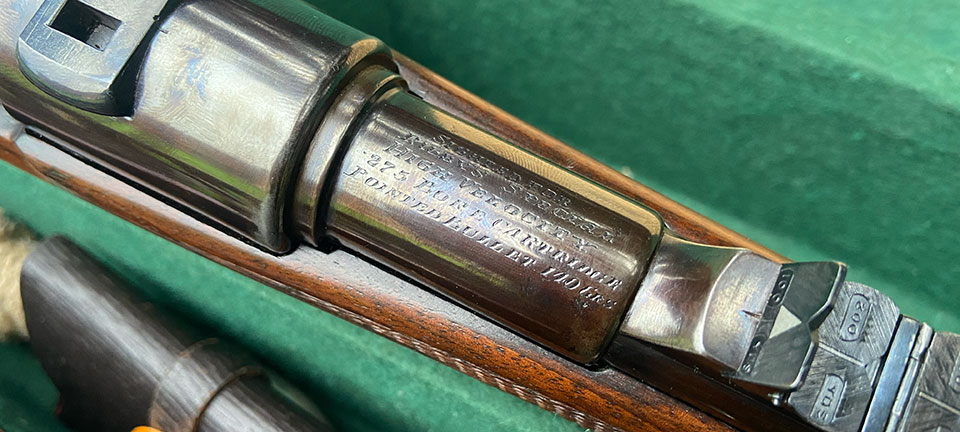
Rifle No. 4309 requires the .275 H.V. cartridge, according to the engraving behind the rear sight block. However, the book notes it was originally made for the ordinary .275, loaded with a 173-grain bullet. It has been sussessfully used for two decades with Federal 140-grain soft points, for which it was regulated by Ron Wharton.
It came with a brick of bespoke rounds Paul Roberts had loaded for it but they are reportedly 'too hot' and cause the bolt to stick when used. Paul told me that when experimenting with H.V. loads for Rigby .275 rifles he found the once-claimed 3,000fps was excessive in practice and that around 2700fps was better and likely what the original ammunition delivered.
These rounds probably come from that experimental period, as the 'sticky bolt' result described by the owner is exactly that which Paul reported as befalling his early attempts to load H.V. cartridges.
This rifle is perfectly reflective of a sporting firearm's journey from the Great War to 2026.
It has been neglected, enjoyed, restored, altered and elevated to modern performance by different owners. A century old, it is still in perfect shape for delivering its 140-grain soft points to the point of aim and putting deer in the larder. It does so with style and history at a third of the price of a new Highland Stalker.
No wonder these old Rigbys have such a dedicated following in the stalking community. Long may it last.
Published by Vintage Guns Ltd on (modified )