Shortly after the Big Bang, the universe was a hot, dense plasma, and for its first 380,000 years, light particles could not travel far, making the universe opaque, like a dense fog.
We can only observe the light from the moment the universe cooled enough for atoms to form, creating an observational and time horizon beyond which telescopes cannot see. There are times when I feel like a frustrated cosmologist trying to pin down those early moments, as I try to lift the mist surrounding the Great Exhibition of 1851 and its aftermath, and shed light on the beginnings of the pin-fire game gun in Britain.
The pin-fire system was invented by the Parisian gunmaker Casimir Lefaucheux, who patented his brilliant masterstroke in 1833. The idea of the cartridge breech-loader grew in France, and other makers began building guns on the new system, either under licence or by developing their own variations on Lefaucheux’s original idea.
Thus, the combination of breech-loading and the pin-fire cartridge was well established in the shooting fields of France and elsewhere on the Continent, before making a public appearance at London’s Great Exhibition of the Industry of all Nations, known ever since as the Great Exhibition of 1851.
The exhibition was the brainchild of Albert, the Prince Consort, and the Society for the Encouragement of Arts, Manufactures, and Commerce. This grand initiative was meant to be a celebration of modern industrial technology and design, at which Britain excelled. Prince Albert was president of the Society when, in 1845, he suggested the exhibition in response to the French Industrial Exposition of 1844 held on the Champs-Élysées in Paris.
six million visitors passed through its gates
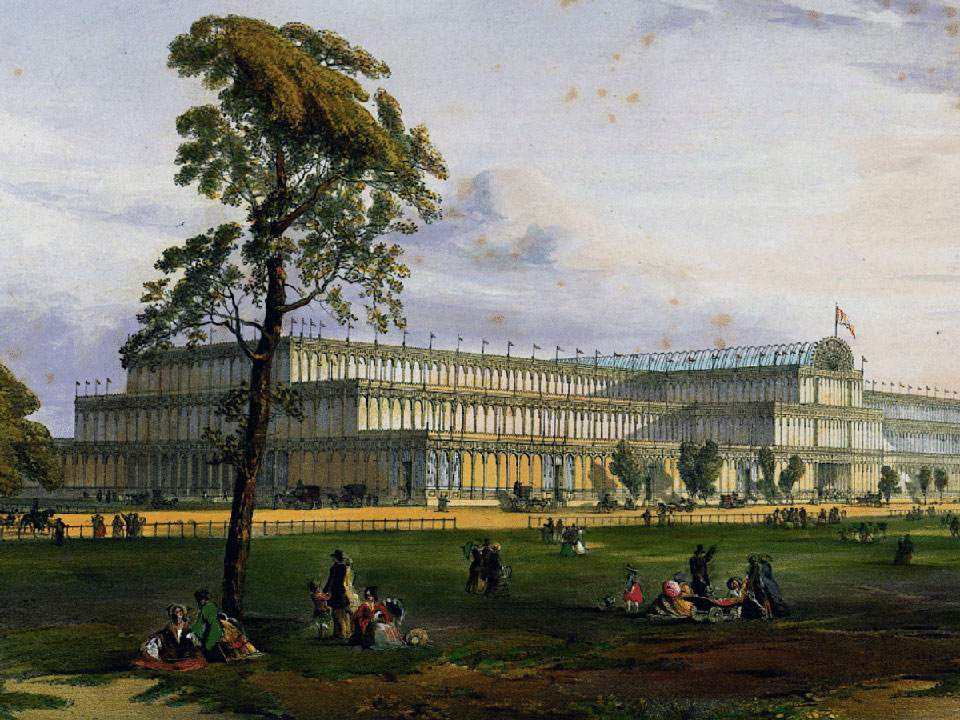
The exhibition offered 991,857 square feet of exhibit space within a 19-acre building dubbed The Crystal Palace, a cast-iron and plate-glass structure designed by Joseph Paxton, which contained 60,000 panes of glass. The exhibition included works from 50 nations and 39 colonies and protectorates, and was opened on 1 May 1851 by Queen Victoria and Prince Albert.
The exhibition ran until October, and some six million visitors passed through its gates. How many of these visited the north side of the Foreign Nave and saw the exhibit of French firearms? It must have been a good number, and would have included British gunmakers and workers from the trade, seeing foreign designs and ideas for the first time. Casimir’s son, Eugène-Louis, presented the Lefaucheux exhibit containing, at the very least, a single-barreled hinge-action fowling piece and a profusely-decorated under-hammer pepperbox pistol, both built on the pin-fire system.
There may have been other Lefaucheux pin-fire guns on display, as the official record does not describe or list the total number of guns in the exhibits. For those who didn’t have the opportunity to attend, The Illustrated London News, with a circulation of about 130,000 at the time, ran an exhibition supplement in its 5 July 1851 edition that had excellent woodcut engravings of the Lefaucheux gun and the pepperbox.

Anyone interested in sporting guns would have certainly taken note of the peculiar breech-loader, either in person or in print. The gun in the exhibit had a forward-facing under-lever over an iron fore-end, a double-bite screw-grip action, and a straight-hand stock — a configuration that would be repeated, with little variation, in many French and Continental pin-fire guns until the beginning of the 20th century.
Oft-repeated convention has it that the London gunmaker Joseph Lang, upon seeing the Lefaucheux gun, developed his own version of the pin-fire breech-loader shortly after the Exhibition closed. This first attempt may have been built by Edwin Charles Hodges, who convinced Lang of its merits and commercial opportunity.
However, by Lang’s own writings, his breech-loader did not appear before late 1853 or early 1854. Furthermore, Lang’s gun, while utilising the pin-fire system, did not copy the Lefaucheux double-bite action or its overall appearance; it had a wooden fore-end and a small forward-facing under-lever instead, and was substantially different from the Lefaucheux Exhibition gun pictured in The Illustrated London News.
at least one Parisian maker, Joseph-François Prélat, was building pin-fire guns in the 1830s
Again, conventional thought is that Lang imposed a British character on Lefaucheux’s invention. Yet in truth, the very features interpreted as British tastes and stylistic improvements were found on pin-fire system guns by several French makers in the years prior to the Exhibition. For example, at least one Parisian maker, Joseph-François Prélat, was building pin-fire guns in the 1830s under licence from Lefaucheux, with a small detachable wooden fore-end, under which was a slim, shortened forward under-lever.
It should also be noted that the Lefaucheux exhibit was not the only French display showcasing sporting guns; 19 other French gunmakers were also presenting their wares. In its description of the Lefaucheux gun, The Illustrated London News mentioned “Claudin and others also have specimens of guns upon the same principle.”
This refers to the exhibit of Ferdinand Claudin of Paris, described as containing “Guns and pistols of new construction,” presumably pin-fires. The ‘others’ who may have presented pin-fire guns or other types of breech-loaders included names such as Beatus Beringer, Adolphe Bertonnet, Louis-François Devisme, Francois Berger, Gilles Michel Louis LePage-Moutier, Louis-Julien Gastine-Renette, Charles Hippolyte Houllier (of Houllier-Blanchard), and Jules Duclos. Louis-Nicolas Flobert of Paris exhibited “Guns, muskets, and pistols, constructed on a new patent principle adopted by most of the gunmakers of France,” which seems to be a reference to the pin-fire system, and would presumably have also included his 1845 invention, the metallic rim-fire cartridge.
Unfortunately, no contemporary descriptions of the guns displayed by these makers are available. Of note, Beatus Beringer of Paris displayed “five fowling pieces,” though the official catalogue did not specify which type these were. By 1851, many, if not most, French gunmakers were building guns based on the designs of Lefaucheux, Beringer, Pierre Antoine Loron of Versailles, and others, all using self-contained cartridges with metallic bases.
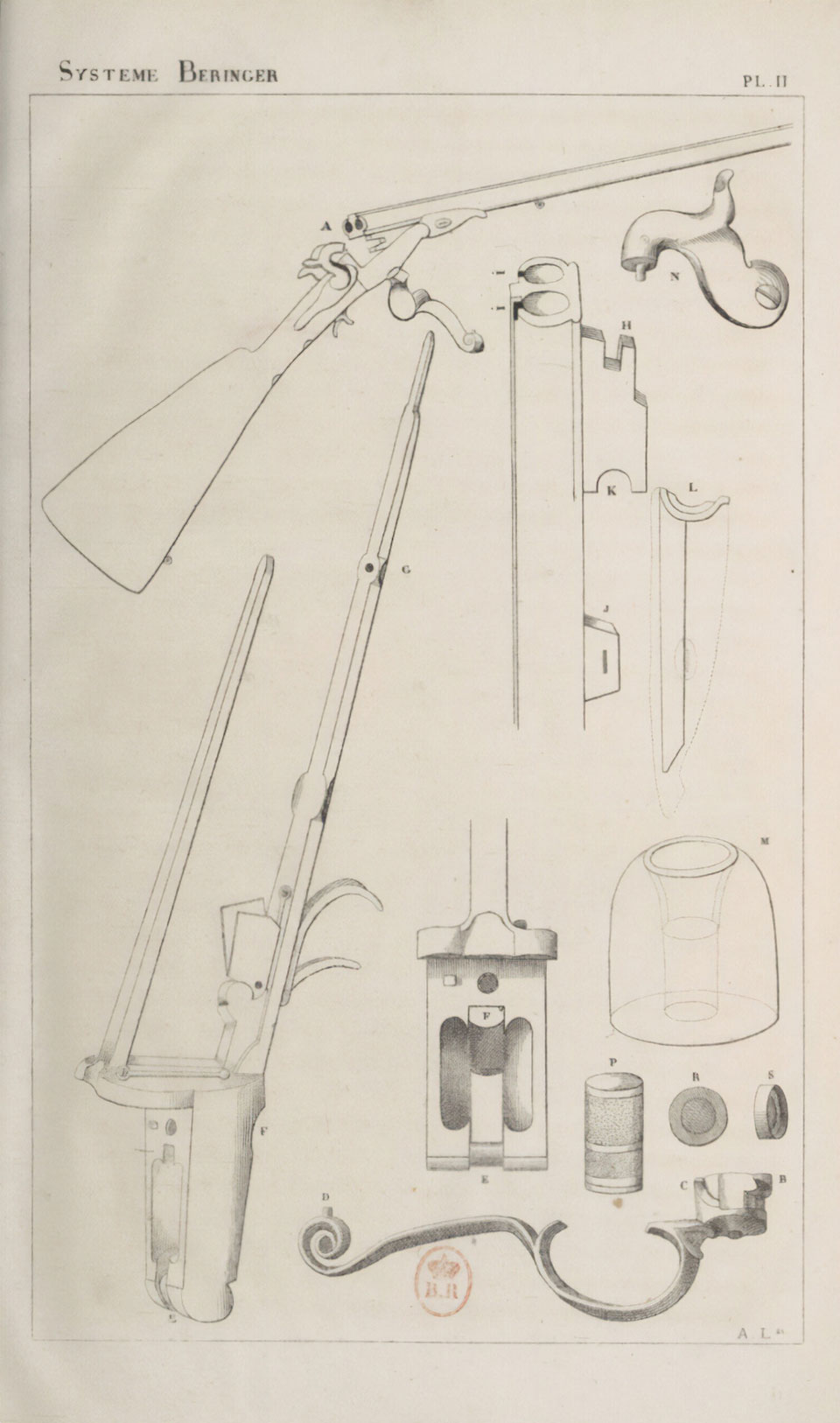
Beringer guns of the period had several interesting characteristics that would become commonplace
Beringer had developed his own system, which allowed his guns to fire either pin-fire cartridges or loose powder and shot loaded into removable breech chambers with percussion nipples. It would be odd indeed if Beringer had not exhibited his proprietary breech-loader, which was at its core a pin-fire gun.
It is worth noting that Beringer guns of the period had several interesting characteristics that would become commonplace in early British pin-fire guns. Beringer’s hinge-action guns, as early as 1837, functioned on the basis of a rearward-facing under-lever, whose shape also formed the trigger guard bow, as had also appeared on some Casimir Lefaucheux guns.
Barrels were affixed with a single-bite engaging an under lug, and working the lever further activated a small stud rising from the action bar to provide leverage in opening the barrels and, when closing the barrels, assisted in returning the lever to its closed position.
Here is Beringer’s action, from Journal des Chasseurs, Paris, 1837: (Source: National Library of France) [Nash_Beringer_Drawing]
As to the appearance and mechanical design of the very first Lang gun, the picture is not so clear. A contemporary source, but still after the fact, is John Henry Walsh's Manual of British Rural Sports, whose preface is dated October 1855 but published in 1856.
In it, Walsh illustrates a Lang gun, clearly showing a Lefaucheux-pattern double-bite action. This is a different configuration from the surviving examples of early Lang breech-loaders, which all have a single-bite. Whether Walsh’s illustration was a generic pin-fire woodcut incorrectly attributed to Lang, or an accurate rendition of a Lang gun at that time, is unclear.
Early examples of British pin-fire game guns can also be found with Beringer’s assisting stud rising from the action bar, though all early Lang actions I have been able to trace or acquire lack this stud (I cannot say for certain whether all did). Was the very first Lang breech-loading gun a straightforward copy of the Lefaucheux action, or was it inspired by Beringer or yet another French maker?
Hodges, as an actioner, built two variations: a straightforward single-bite action for Lang’s guns, and for other gunmakers, a version with the Beringer rising stud.
Here is an example of Lang’s pin-fire breech-loader dating from 1858 (Atkin Grant & Lang graciously confirmed the date), the year The Field hosted its first public trial to test the merits of the new breech-loader against the ‘common gun,’ the muzzle-loader. The hammers are incorrect replacements. [Nash_Lang_1858]
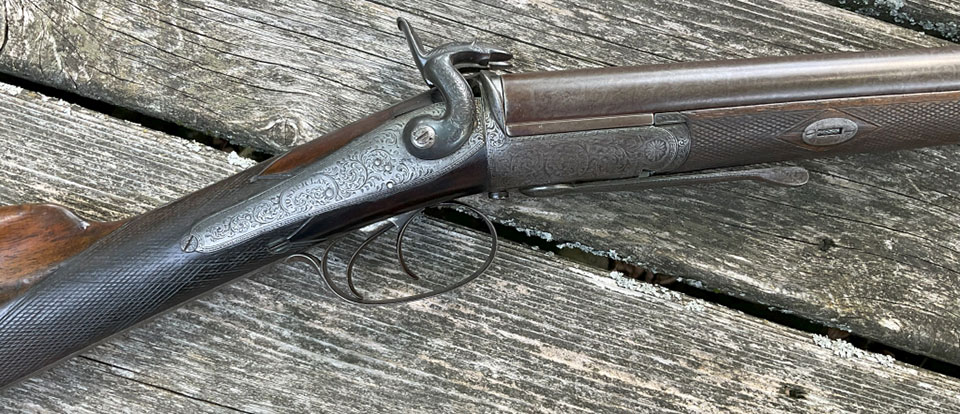
Pictured below is a later Lang gun, dating to 1867, with a rear-facing underlever, but still using the single-bite action identical to that of the 1858 example. [Nash_Lang_1867]
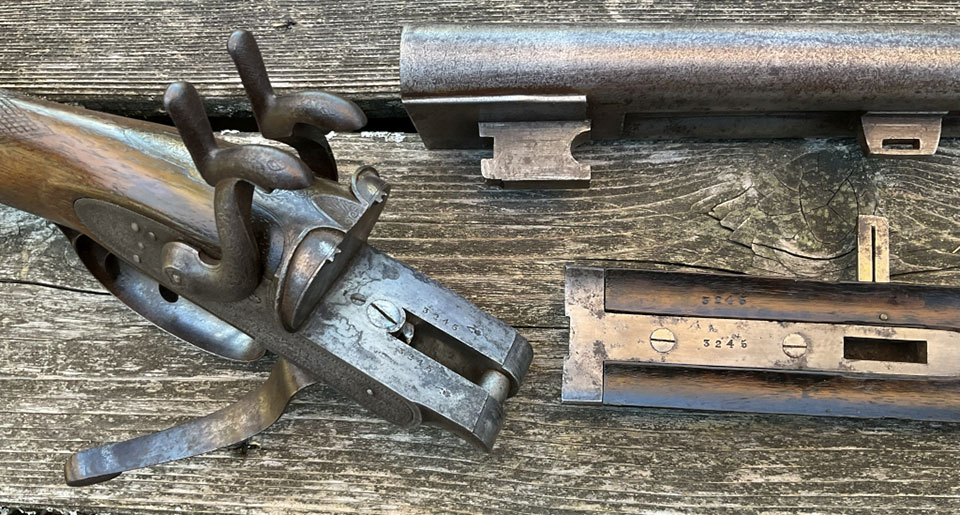
The alternative on the British market was the single-bite design after Beringer, here on a gun by John Blissett of London, actioned by Hodges. Note the rising stud on the action bar. This action variation appeared on the earliest pin-fire guns built by John Blanch, Edward Michael Reilly, William Moore, and others in London and elsewhere. [Nash_Blissett_Hodges]
Here are both actions side by side, showing the Lang version lacking the rising stud, and the Beringer-inspired design widely used by Blissett and other makers. [Nash_Blissett_Lang]

Few British-made breech-loaders were in circulation prior to the 1858 trial, making surviving examples rare and the study of them difficult. There were some actions of Continental make and design appearing on the British market, either imported in the white and locally built, or as re-branded complete guns.However, by the end of the 1850s, there were sufficient providers of British breech-loaders that such hybrid guns dwindled in popularity.
By the early 1860s, there were improved designs on the market, such as Henry Jones’s double-bite screw-grip, James Dalziel Dougall’s Lockfast, and myriad clever snap-actions. The original single-bite, forward-underlever configuration would eventually be superseded by these better and stronger designs.
Lang’s gun might even have been copied from another French maker,
Joseph Lang introduced Lefaucheux’s pin-fire system to the British public. The question I seek to answer is, was Lang’s gun influenced by the mechanical design of Casimir Lefaucheux, as is commonly attributed, or that of Beatus Beringer? It would appear to me to be the latter. Lang’s gun might even have been copied from another French maker, a contemporary of Lefaucheux and Beringer.
To further muddy attempts at clarification, all pin-fire guns in Britain were called Lefaucheux actions, regardless of their origin or variation. Adapting or copying an action would have required getting one's hands on a French gun to disassemble and examine closely, as John Blanch did in 1855 when he acquired a Beringer gun to study.
It seems evident that Lang must have done something similar in the two or three years after the Great Exhibition, before putting his version on the market. As the Lang prototype appears not to have survived, we can only conjecture about whose design was first copied. That dense fog at the very beginning of the British breech-loader is one that cannot yet be pierced, but some clues are slowly emerging, and I remain hopeful of finding an answer.
Text and photographs by Stephen Nash
Published by Vintage Guns Ltd on (modified )